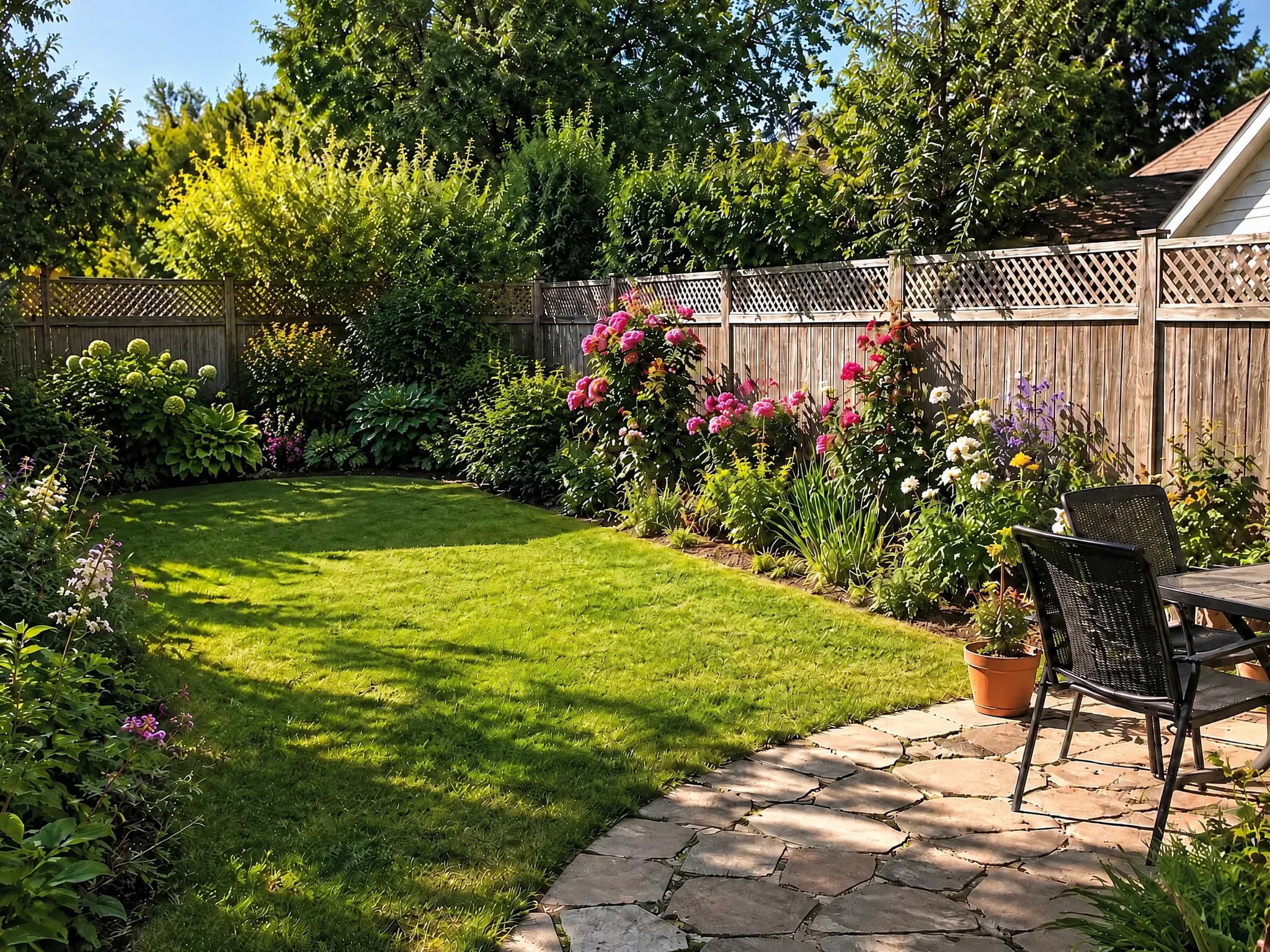
A before and after landscape transformation is the fastest way to understand what a design style actually does to a yard. Mood boards show finished gardens; a before-and-after shows the same dull patch of lawn becoming something else. That is also the most honest way to judge an AI landscape design tool: if the "before" looks like your yard, the "after" is a fair preview of what you would get.
Below are ten transformations from our gallery, each made by uploading a single ordinary photo to the AI Landscape Design tool. For each one you will see what changed, why it works, and what to take from it for your own yard. These are AI-generated visualizations, not built projects. They are concepts for deciding on a direction, and we say more about their limits at the end.
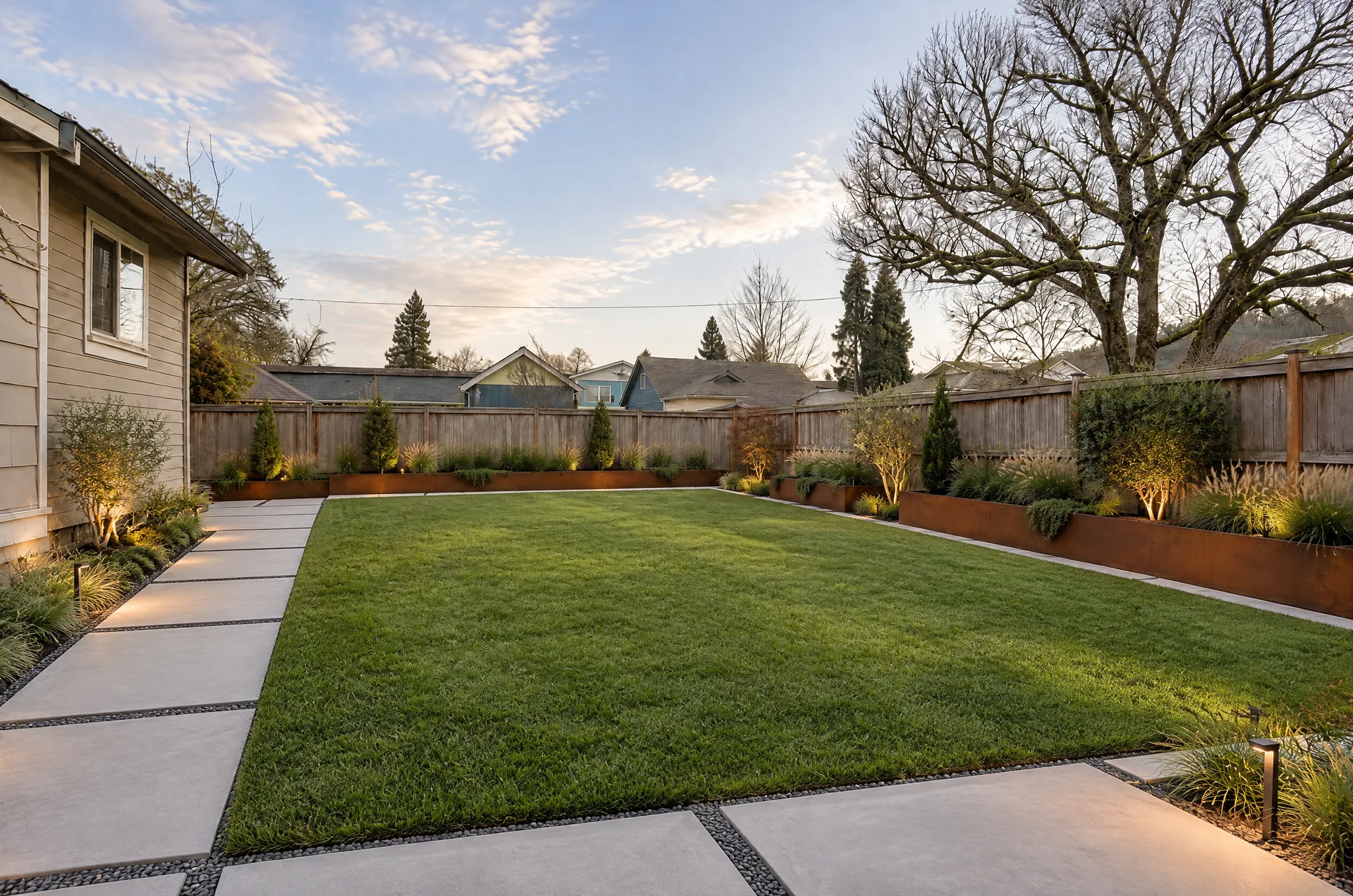
1. Patchy Lawn to Modern Minimalist Backyard
The original is a neglected lawn with no structure. The redesign adds large-format light-gray pavers framing a crisp rectangle of lawn, with Corten steel raised planters holding feather reed grass and river-stone mulch, plus low built-in lights.
What to copy: a short material palette. Three or four materials repeated consistently is what gives modern minimalist yards their calm. Straight edges and a clear geometry do more than any single plant.
2. Builder-Grade Front Yard to English Cottage Garden
A garage-dominated front yard gets a rustic arbor wrapped in climbing roses at the entry, a gravel path between clipped boxwood, and layered borders of delphiniums, peonies and roses.
What to copy: the arbor. A single vertical feature at the entry gives a flat yard a destination and softens a garage-heavy facade. The English cottage style also proves that layered planting, not square footage, creates curb appeal. Our cottage garden guide covers the plants and spacing.
3. Bare Lawn to Tropical Retreat
Palms form the canopy, banana-leaf plants and bird of paradise fill the middle layer, and a timber deck wraps a compact plunge pool. A stepping-stone path and tiki torches finish the resort feel.
What to copy: layering. The tropical resort look depends on three heights of planting rather than open lawn. Check your climate before you commit, though: many of these plants need a frost-free zone or a pot you can bring inside.
4. Patchy Lawn to Japanese Zen Garden
Raked white gravel ripples around mossy islands and boulders in a karesansui dry landscape. Flat stepping stones cross the gravel, and a bamboo grove, small Japanese maples and a screen-style fence frame the view.
What to copy: gravel standing in for water and boulders for mountains. A Japanese zen garden makes a small yard feel open because it leaves empty space on purpose. If you want the principles behind it, read our zen garden design principles.
5. Bare Front Yard to Mediterranean Garden
A mature olive tree anchors the lawn, lavender fills low stone-edged beds, terracotta pots hold red geraniums, and a tiered fountain adds sound beside a gravel path.
What to copy: gravel mulch plus drought-tolerant planting. It cuts water use while keeping the courtyard look of the Mediterranean style. The Mediterranean garden guide lists plants by sun and soil.
6. Cracked Slab to Modern Rustic Fire Pit Patio
A cracked, weedy slab and dry lawn become a round rust-brown steel fire pit on dark flagstone, ringed by cushioned Adirondack chairs, with string lights, a cedar privacy fence, ornamental grasses and yellow flower beds.
What to copy: the seating circle. A fire pit with chairs placed around it is the layout that makes a patio feel finished. The same idea works for budgets large and small, from a prefab steel bowl to a built stone ring.
7. Eroded Slope to Terraced Mediterranean Garden
An eroded, patchy hillside behind a chain-link fence becomes stacked stone retaining walls holding lavender, rosemary and olive trees, with flagstone steps between levels and a bistro table on the top terrace.
What to copy: treat the slope as several small flat rooms. Terraces make a "too steep to use" area functional. Realistically, retaining walls of any height may need engineering and a permit in your area, so use a visualization like this to decide what you want, then get professional input on how to build it.
8. Dying Lawn to Desert Xeriscape Front Yard
Patchy brown grass beside a plain driveway turns into a river-rock dry creek bed, golden barrel cactus, blue agave and red yucca, with large boulders, a flagstone walkway and a palo verde tree.
What to copy: the dry creek bed. It handles runoff, adds a focal line, and uses stone instead of water. See our desert xeriscape style page and the drought-tolerant landscaping guide for plant choices that fit dry regions.
9. Bare Fenced Corner to Woodland Pond Garden
Patchy grass and a plain wood fence become a small stone waterfall spilling into a still pond, with moss-covered boulders, ferns, hostas and ornamental grasses, a flagstone stepping path and a white-flowering dogwood by the fence.
What to copy: put water in a corner, not the middle. A small pond in an otherwise bare corner turns an unused spot into a destination. The woodland naturalistic style leans on shade-tolerant plants, which makes it a good match for fenced and tree-covered yards.
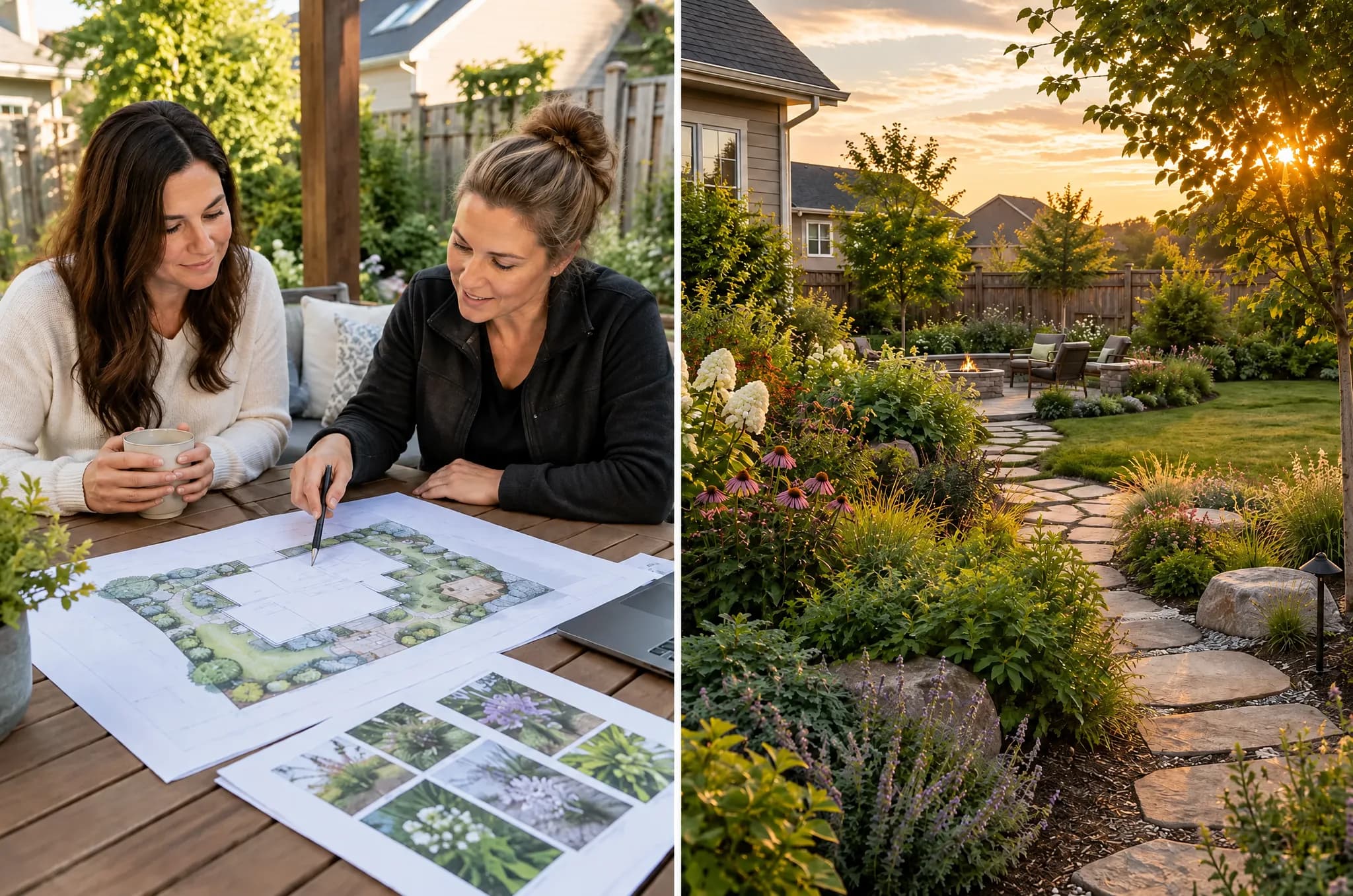
10. Cracked Concrete to Modern Pergola Dining Patio
A stained slab beside the house becomes an outdoor dining room: a black steel pergola with a wood-slat roof and sheer curtains, a long teak table with woven chairs, large pale pavers, black raised planters and string lights.
What to copy: define the room. A pergola, a rug-sized paved area and a table make an outdoor "room" even without walls.
What These Transformations Have in Common
Looking across all ten, a few patterns show up again and again:
- A clear focal point. An arbor, a fire pit, a pond, a tree. Each before-and-after has one thing your eye goes to first.
- A limited palette. Four or five materials, repeated.
- Layers of height. Ground cover, mid-height plants and something tall.
- Edges and paths. Even the most naturalistic gardens have a defined way to walk through them.
- Climate-appropriate planting. The xeriscape yard and the tropical retreat look nothing alike because they are suited to different climates.
How to Get Results Like These From Your Own Photo
- Photograph the yard in good light. Stand where you can see the whole area, keep the camera level, and avoid harsh midday shadows. For more detail on photographing your yard, see our complete guide to backyard transformation.
- Upload it to the landscape design tool and choose one of 25 landscape styles, or leave it on AI Recommend.
- Add one or two instructions. "Keep the existing tree and fence" works better than a long wish list.
- Compare and tweak. Use the slider to compare, and the tweak box to change one thing at a time.
- Try a second style. Putting two styles on the same photo is often the quickest way to learn what you actually like.
Reading AI Renderings Honestly
An AI visualization shows a plausible look, not a buildable plan. Some practical limits:
- Scale is approximate. Measure before you buy anything. A rendering cannot tell you if a pergola fits a 10-foot patio.
- Plants may not suit your zone. Check hardiness and sun exposure for every plant you like.
- Costs are not included in the picture. Our result pages show typical budget ranges per style, but local labor, materials and permits vary widely.
- Structural work needs professionals. Retaining walls, pools, electrical and gas lines need qualified contractors and often permits.
Used that way, a visualization is a cheap first step. For a deeper comparison, see AI landscape design versus hiring a designer.
Try Your Own Transformation
Upload one photo of your yard to the free AI landscape design tool and see what a different style does to it. New visitors get 2 free designs without signing up, and free results carry a small watermark. To keep exploring, browse the full gallery or the style library.