Japanese Zen gardens represent one of the world's most refined landscape design traditions. Rooted in centuries of Buddhist philosophy, these gardens distill nature into its essential forms, creating spaces that invite contemplation and stillness.
Whether you want to build an authentic karesansui (dry landscape garden) or simply bring Zen-inspired elements into your existing yard, understanding the underlying principles will guide you toward a more meaningful design.
The Philosophy Behind Zen Gardens
Zen gardens emerged from Japanese Buddhist monasteries during the Muromachi period (1336 to 1573). Unlike Western gardens that celebrate abundance and color, Zen gardens practice restraint. Every element is placed with intention, and empty space is valued as much as filled space.
Three core philosophical concepts guide Zen garden design:
Wabi -- finding beauty in simplicity and imperfection. A moss-covered stone is more valued than a polished sculpture.
Sabi -- appreciating the patina of age and the passage of time. Weathered materials are preferred over new ones.
Ma -- the powerful role of negative space. What you leave out defines the garden as much as what you include.
Essential Elements
1. Stone (Ishi)
Stones are the backbone of a Zen garden. They represent mountains, islands, or natural formations and are selected for:
- Shape: Tall vertical stones (tate-ishi), low flat stones (yoko-ishi), and arching stones (shigyo-ishi) create balanced groupings
- Surface texture: Weathered, moss-friendly surfaces are preferred
- Groupings: Odd numbers (3, 5, 7) arranged in naturalistic clusters
Stone placement follows the principle of shingyoso -- a combination of formal, semi-formal, and informal arrangements that create dynamic tension.
2. Gravel and Sand (Suna)
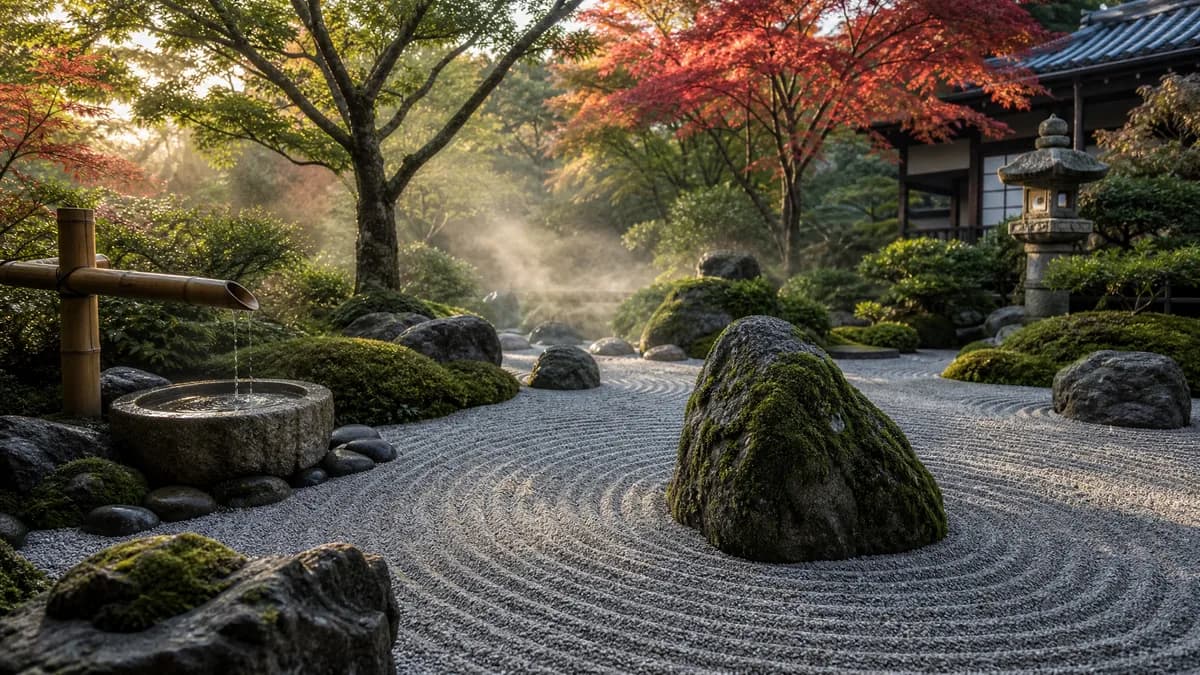
Raked gravel or sand represents water in dry landscape gardens. Common patterns include:
- Straight lines representing calm, flowing water
- Concentric circles around stones representing ripples from dropped objects
- Wavy patterns representing ocean currents
- Swirl patterns representing eddies and movement
The daily practice of raking these patterns serves as a form of moving meditation.
3. Water (Mizu)
When water is present in a Zen garden, it appears in controlled forms:
- Tsukubai (stone water basin) placed low so visitors must bow to wash hands
- Shishi-odoshi (deer scarer) bamboo water feature that clicks rhythmically
- Small ponds with koi, designed to be viewed from specific vantage points
4. Plants (Shokubutsu)
Plant selection emphasizes restraint and symbolism:
- Moss -- represents age, patience, and the forest floor
- Japanese maple (Acer palmatum) -- seasonal change, the impermanence of beauty
- Bamboo -- resilience, flexibility, and strength
- Pine (Matsu) -- longevity and steadfastness
- Pruned azaleas -- controlled forms representing hills and clouds
5. Structures
Traditional structures include:
- Stone lanterns (toro) placed at path intersections
- Stepping stones (tobi-ishi) that control pace and direction of movement
- Bamboo fencing (take-gaki) for screening and boundary definition
- Wooden gates (mon) marking transitions between garden sections
Design Principles for Your Garden
You do not need a Japanese heritage or a large space to apply Zen principles:
Principle 1: Asymmetry Over Symmetry
Avoid centering elements or creating mirror-image layouts. Nature is asymmetric, and Zen gardens honor this by placing elements in off-center, balanced compositions.
Principle 2: Borrowed Scenery (Shakkei)
Frame views of distant mountains, trees, or sky as part of the garden composition. This technique makes small gardens feel connected to a larger landscape.
Principle 3: Concealment and Reveal (Miegakure)
Design paths that curve around obstacles, revealing new views as visitors move through the space. Never show the entire garden from a single vantage point.
Principle 4: Economy of Means
Use fewer, higher-quality elements rather than many mediocre ones. A single beautiful stone is more impactful than a dozen ordinary ones.
Creating a Zen Corner in Any Yard
Even if your entire yard cannot become a Zen garden, you can dedicate a corner to Zen-inspired design:
- Select a quiet, partially shaded area
- Install a gravel base with landscape fabric underneath
- Place 3 to 5 carefully chosen stones in an asymmetric grouping
- Add moss or low ground cover around the stone bases
- Include a single specimen plant (Japanese maple or shaped pine)
- Add a stone lantern or water basin as a focal point
- Keep the perimeter defined with bamboo fencing or a hedge
Visualize a Zen Transformation
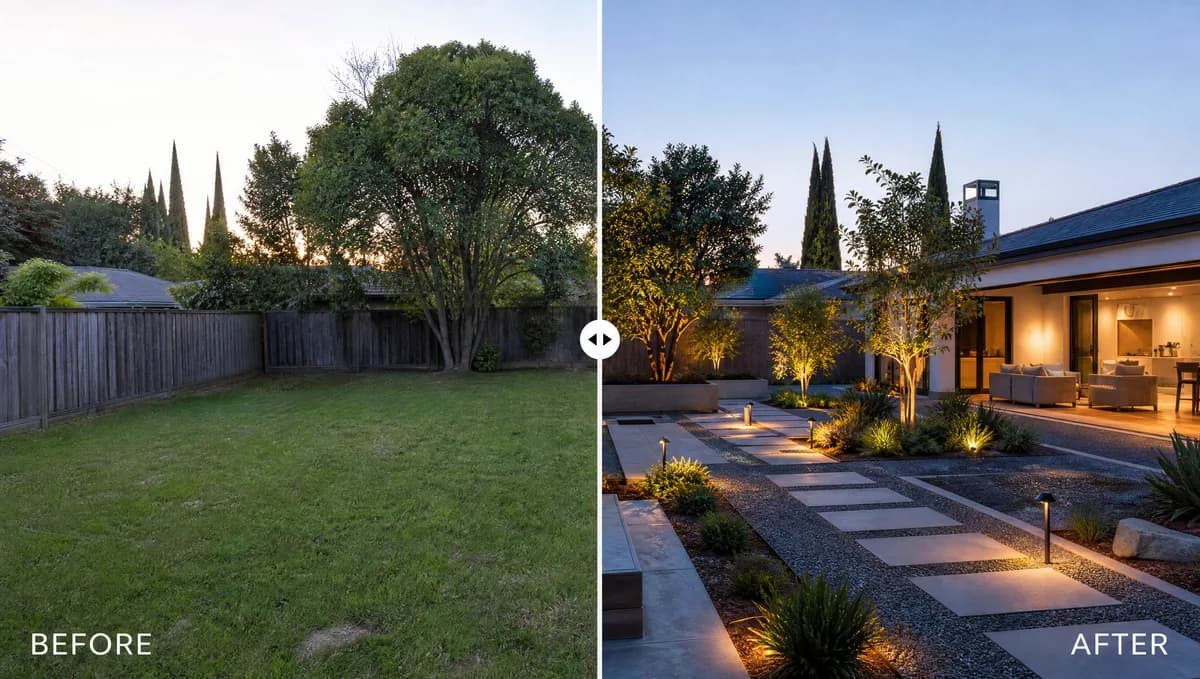
Upload a photo of your yard to our AI design tool and select the Japanese Zen garden style to see how these principles would transform your specific space. The AI applies authentic design patterns including stone groupings, gravel patterns, and appropriate plant selection to create a photorealistic visualization.
For complementary styles, also explore Chinese Jiangnan gardens (which influenced Japanese garden design) and Scandinavian landscapes (which share Zen's appreciation for simplicity).
Frequently Asked Questions
How much maintenance does a Zen garden require? Gravel patterns need re-raking after rain or wind. Moss requires consistent moisture. Pruning shaped plants is an ongoing practice. Overall, maintenance is moderate but meditative.
Can I create a Zen garden in a cold climate? Zen gardens work in all climates. Choose cold-hardy moss varieties, stone (which is unaffected by freeze-thaw), and native plants that share the aesthetic qualities of traditional Zen plantings.
What size space do I need for a Zen garden? Even a 6-by-8-foot area can accommodate a meaningful Zen garden with a few stones, raked gravel, and a specimen plant.