Mid-century modern landscape design is the rare style that has outlasted the era that created it. Born between the 1940s and 1960s alongside the work of architects like Richard Neutra, Eero Saarinen, and Craig Ellwood, it was never just about the houses — the landscape was always the other half of the equation. The flat rooflines, floor-to-ceiling glass, and open floor plans demanded an outdoor space that extended the living room, not merely decorated the perimeter. Today, mid-century modern landscape style is experiencing a full revival: homeowners in 2026 are drawn to its clean geometry, honest materials, and the effortless way it dissolves the boundary between indoors and out.
The appeal is not nostalgia. It is function. A mid-century landscape is built around low maintenance, strong structure, and year-round visual interest — three qualities that align perfectly with current trends toward drought-tolerant planting, sustainable materials, and outdoor living rooms. Whether you own a 1957 ranch or a new-build that borrows the aesthetic, this guide covers every element you need: design principles, real plant recommendations, hardscape materials, layout strategy, and budget guidance.
The Design Philosophy Behind Mid-Century Landscapes
Mid-century modernism trusted a simple premise: good design should serve daily life, not perform for guests. The landscape extension of this idea rests on four pillars.
1. Indoor-Outdoor Flow
The defining feature. Floor-to-ceiling glass walls, sliding doors, and covered patios were designed so that the garden is visible from — and continuous with — interior spaces. The landscape does not begin at the back door; it begins at the living room window. Materials often continue from inside to outside: a concrete floor extends into a patio, a wood ceiling becomes a pergola overhead.
2. Geometric Clarity
Straight lines, right angles, and repeating modules organize the space. Walkways are clean-edged. Planting beds are rectangular or L-shaped. Pavers follow a grid. Curves appear only when they serve purpose — a round fire pit, a circular planter — never as arbitrary decoration. This geometric backbone is what gives mid-century landscapes their visual calm.
3. Honest Materials
Concrete, natural stone, warm-toned timber, steel, and gravel are presented as themselves. Nothing is faux. Concrete is left exposed or lightly brushed, not stamped to imitate flagstone. Timber is oiled or left to weather, not painted. Metal is raw steel or anodized aluminum, developing patina naturally. The materials age gracefully rather than requiring constant renewal.
4. Architecture Through Plants
Plants in a mid-century landscape are not filler — they are sculptural elements with the same visual weight as a wall or a roof beam. An agave is a living sculpture. A row of ornamental grasses is a soft wall. A single Japanese maple is a canopy that defines a room. This architectural approach means fewer plants overall, each chosen with intention and placed with precision.
Essential Plants for a Mid-Century Modern Landscape
The plant palette is restrained and sculptural. You are building structure, not filling beds.
Architectural Accent Plants
These are the showpieces — bold forms that anchor the design like furniture anchors a room.
| Plant | Character | USDA Zones | Role |
|---|---|---|---|
| Agave (Agave americana) | Blue-gray rosettes, dramatic spines | 8–11 | Specimen at entry points and focal walls |
| Yucca (Yucca rostrata) | Spherical blue canopy on trunk | 5–11 | Vertical accent beside walkways or pools |
| Bird of paradise (Strelitzia reginae) | Sculptural orange flowers, paddle leaves | 9–11 | Color accent in containers or borders |
| Japanese maple (Acer palmatum) | Layered canopy, brilliant fall color | 5–8 | Understory tree for courtyard or patio edge |
| Sago palm (Cycas revoluta) | Dark green feathered fronds | 8–11 | Symmetrical form for flanking doorways |
Ornamental Grasses
Grasses are the mid-century landscape's soft architecture — they create screens, borders, and rhythm without hard edges.
- Feather reed grass (Calamagrostis × acutiflora 'Karl Foerster') — Perfectly upright columns that hold structure through winter. Plant in rows of 5–7 along walkways or property lines.
- Mexican feather grass (Nassella tenuissima) — Fine, flowing texture that catches light and breeze. Mass-plant in gravel beds for a softening effect.
- Blue oat grass (Helictotrichon sempervirens) — Metallic blue mounds that complement concrete and gravel. Use as edging or specimen clusters.
- Maiden grass (Miscanthus sinensis 'Gracillimus') — Arching habit with silvery plumes in autumn. Effective as a living screen.
- Little bluestem (Schizachyrium scoparium) — Blue summer foliage turns copper in fall. Excellent in dry gravel gardens.
Succulents and Desert Plants
In warm-climate and drought-conscious mid-century landscapes, succulents replace traditional border plants entirely.
- Echeveria — Tight rosettes in blue, pink, or green. Mass-plant at path edges or in geometric raised beds.
- Aloe (Aloe spp.) — Sculptural, spiky forms with seasonal blooms. Coral-toned flowers add the pop of warm color the style favors.
- Barrel cactus (Echinocactus grusonii) — Golden spines glow in low sunlight. Use singly or in clusters of three against a wall.
- Sedum (Sedum spp.) — Low-growing groundcover for green-roof sections, gaps between pavers, or gravel garden pockets.
Low Hedging and Groundcover
Clean edges matter in mid-century design. These plants provide definition without requiring excessive trimming.
- Boxwood (Buxus spp.) — Low, dense hedges to define planting beds. Keep at 12–18 inches for the crisp, horizontal look the style demands.
- Dwarf mondo grass (Ophiopogon japonicus 'Nana') — Dark green strips between pavers or along walkways.
- Creeping thyme (Thymus serpyllum) — Fragrant, drought-tolerant groundcover in gravel joints and stepping stone gaps.
Materials and Hardscape
Materials carry as much visual weight as planting in a mid-century landscape. Choose honestly and let them age.
Concrete
The signature material. Use it in three forms:
- Large-format pavers (24" × 24" or larger) — Laid in a grid with 2-inch gravel or grass joints. Clean edges are essential; avoid tumbled or irregular finishes.
- Poured-in-place patios and walkways — Brush-finished or lightly exposed aggregate for texture without fussiness.
- Concrete planters — Cylindrical or rectangular, in natural gray. Group in sets of two or three at varying heights.
Timber
Warm timber balances the coolness of concrete and stone. Mid-century design favors:
- Cedar or teak for furniture, pergolas, and horizontal fence slats
- Redwood for raised planters and deck surfaces
- Horizontal board fencing — 1" × 6" boards with 1" gaps, stained dark or left to weather
Breeze Block
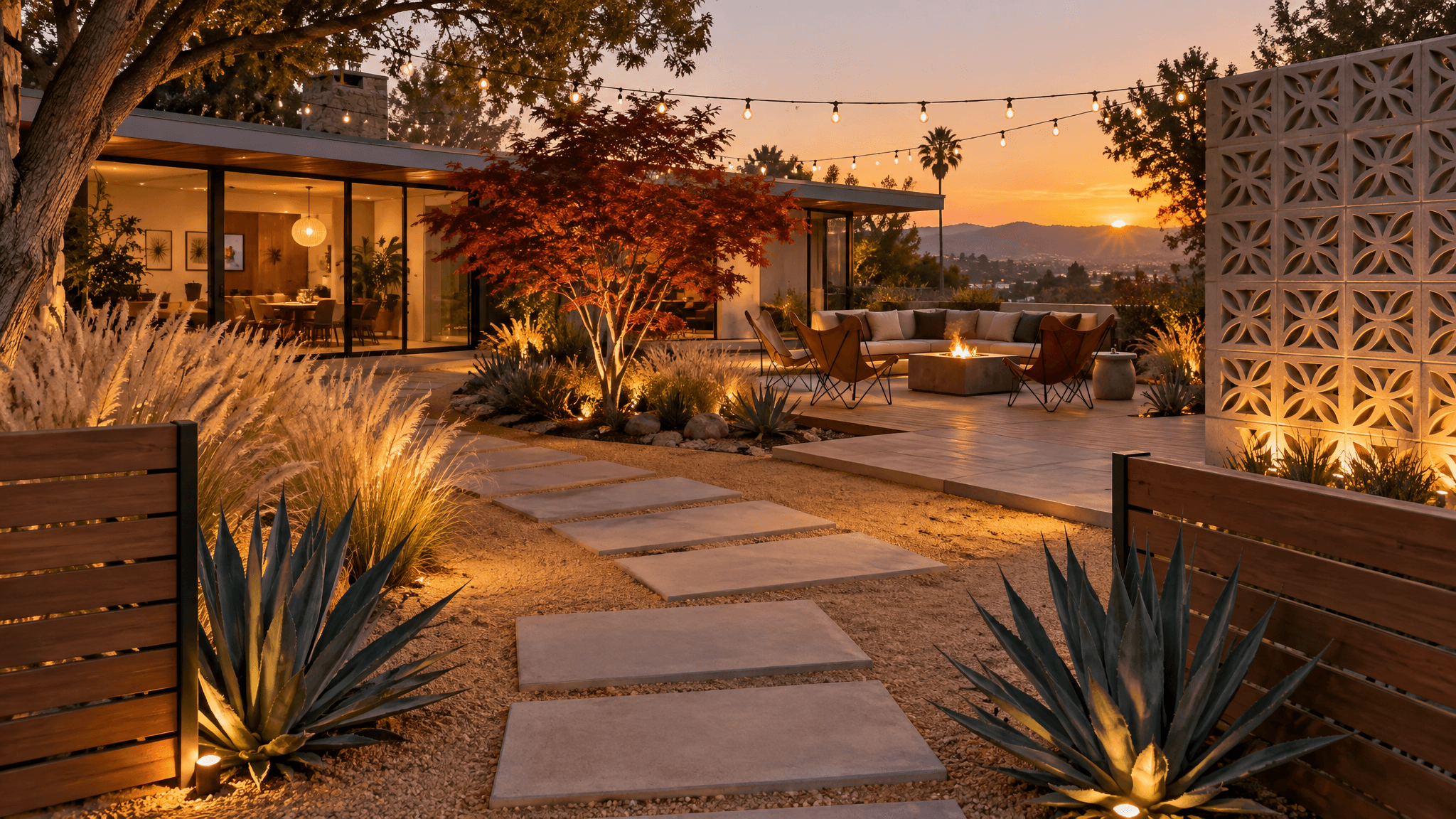
The most recognizable mid-century hardscape element. Decorative concrete blocks arranged in geometric patterns serve as screens, garden walls, and space dividers. They filter light and air while providing privacy — functional and sculptural at once. A breeze block wall with LED uplighting becomes a dramatic focal feature after dark.
Gravel and Decomposed Granite
For ground planes around plantings and between pavers. Choose muted tones:
- Decomposed granite in tan or gold — warm and natural beside warm-toned timber
- Pea gravel in gray or white — clean and reflective beside concrete
- Crushed granite in charcoal — a modern update for contrast against light-colored walls
Metal Accents
- Corten steel edging and planters — rust-toned patina that deepens over years
- Powder-coated steel in black or white — for mailbox posts, address numbers, and light fixtures
- Aluminum — period-correct for patio furniture and pergola details
Layout Strategy: Designing Your Mid-Century Landscape
The Indoor-Outdoor Connection
Start from the house. Identify every window, glass door, and covered transition. The landscape design radiates outward from these connection points, not inward from the property line. The goal is to make the garden feel like an extension of the floor plan.
Zone the Space
Divide the landscape into three interlocking zones:
-
Transition Zone — The first 6–10 feet from the house. This is where indoor and outdoor materials merge. Continue interior flooring material (or match it visually) into a covered patio. Place container plants here that are visible from inside. This zone gets the most use and should be the most refined.
-
Living Zone — The main outdoor room. An open-air area with seating, a fire pit or fireplace, and possibly a pool or water feature. Defined by low walls, planters, or hedge lines rather than fences. Concrete paving with gravel joints sets the floor. Overhead, a pergola or mature tree provides filtered shade.
-
Perimeter Zone — The outer edges where specimen plants, screens, and privacy planting live. Rows of ornamental grasses along fences, tall yucca or bamboo for height, and massed groundcover under trees. This zone requires the least maintenance and the most structural planting.
Design Moves That Work
- Floating pavers in gravel — Large concrete squares set in a field of decomposed granite. The simplest and most iconic mid-century ground treatment. Walk on our landscape design tool to visualize this instantly.
- Specimen plant as focal point — One large agave, yucca, or Japanese maple placed asymmetrically against a wall or at a path junction. Lit from below at night.
- Horizontal lines — Reinforce the low, horizontal proportions of mid-century architecture. Low walls at 18–24 inches, horizontal fence slats, wide shallow planters, and spreading groundcover all emphasize the horizon.
- Repeat modules — Use one planter type in three sizes. Plant one grass species in multiple locations. Repeat one paver size throughout. Repetition is not boring — it is the rhythm that holds the design together.
- Warm outdoor lighting — String lights, step lights, and uplights at 2700K. Avoid cold white. Light the breeze block wall, uplight one specimen tree, and wash a path edge with low bollard lights. The backyard design ideas page has more lighting inspiration.
Front Yard Application
Mid-century front yards are uniquely impactful because the style's clean geometry reads powerfully from the street. Key moves:
- Replace conventional lawn with a gravel-and-paver grid
- Line the walkway with a single grass species (Karl Foerster feather reed grass is the classic choice)
- Frame the entry with a pair of architectural plants — two matching agave or yucca
- Install a horizontal slat fence or breeze block screen for privacy without visual weight
- Use address numbers, mailbox, and lighting as intentional design objects, not afterthoughts
Budget Guide
Mid-century landscapes reward restraint. Because the palette is limited, materials can be higher quality without blowing the budget.
| Level | What You Get | Estimated Cost (USD) |
|---|---|---|
| DIY Starter | Concrete paver grid in gravel + 3 specimen plants + 10 ornamental grasses + simple seating area | $3,000 – $7,000 |
| Mid-Range | Professional concrete + cedar fence/pergola + breeze block wall + irrigation + landscape lighting + planting | $12,000 – $28,000 |
| Premium | Architect-designed with poured concrete, custom breeze block, pool integration, mature specimens, and full lighting scheme | $35,000 – $80,000 |
Cost-saving strategies: Source large concrete pavers from commercial suppliers rather than landscape retailers — prices are often 40% lower. Plant grasses and succulents from small sizes (1-gallon or plugs) — they fill out within one to two growing seasons. Build a breeze block wall yourself using a standard running bond pattern and basic masonry skills. Phase the project over two seasons: hardscape first, planting second.
Maintenance: Less Than You Think
A well-designed mid-century landscape is inherently low-maintenance because it relies on structure over abundance.
Seasonal Tasks
- Spring: Cut back ornamental grasses to 4–6 inches before new growth. Refresh gravel surfaces. Feed succulents with a balanced slow-release fertilizer.
- Summer: Water newly planted specimens weekly until established. Established drought-tolerant plants need little to no irrigation. Trim boxwood hedges once to maintain clean lines.
- Fall: Clean fallen leaves from gravel and pavers. Enjoy fall color on Japanese maples and grasses turning golden. Plant spring bulbs in geometric drifts for February–March interest.
- Winter: The structural beauty of the landscape is most visible now — bare branches, frosted grasses, and architectural plants against clean hardscape. No maintenance required.
Long-Term
- Concrete pavers may develop patina — this is desirable, not a problem to fix
- Timber furniture and fencing should be oiled annually with teak or cedar oil, or left to weather naturally
- Breeze block walls need repointing every 10–15 years in harsh freeze-thaw climates
Common Mistakes to Avoid
Cluttering the plant palette. If your plant list exceeds 8–10 species, it is no longer mid-century — it is cottage gardening in disguise. Edit until every plant earns its place through structural contribution.
Using faux materials. Stamped concrete pretending to be flagstone, vinyl fencing pretending to be wood, and plastic planters pretending to be concrete all violate the fundamental mid-century principle of material honesty. Use the real thing in a smaller quantity if budget is tight.
Ignoring the house connection. A beautiful outdoor space that does not relate to the architecture is a missed opportunity. Always design from the glass wall outward.
Over-lighting. Mid-century lighting is warm and selective — three to five light points, not a stadium wash. Uplight one tree, wash one wall, and string lights over the seating area. That is enough.
Forgetting the vertical plane. Horizontal lines are essential, but without a vertical counterpoint — a tall yucca, a slender tree, or a breeze block wall — the landscape reads as flat and featureless.
Mid-Century Modern vs. Contemporary Minimalist
Both styles value clean lines, but they are distinct:
- Mid-Century is warm — cedar, golden gravel, terracotta-toned succulents, brass accents. It references a specific architectural era and embraces its visual vocabulary: breeze block, butterfly chairs, sputnik lighting.
- Contemporary Minimalist is cool — white concrete, gray gravel, monochrome plantings, black steel. It references no particular era and pursues pure abstraction.
If your house has mid-century bones — low roofline, exposed beams, large windows — the mid-century landscape completes the story. If it is a modern box with no historical reference, the modern minimalist approach may be a cleaner match.
Visualize Your Mid-Century Landscape
Unsure whether this style suits your property? Upload a photo of your yard to our AI landscape design tool and see it transformed into a mid-century modern landscape in seconds. The AI preserves your existing structures and reimagines the space with clean pavers, architectural plantings, and warm timber — no commitment, no sign-up needed.
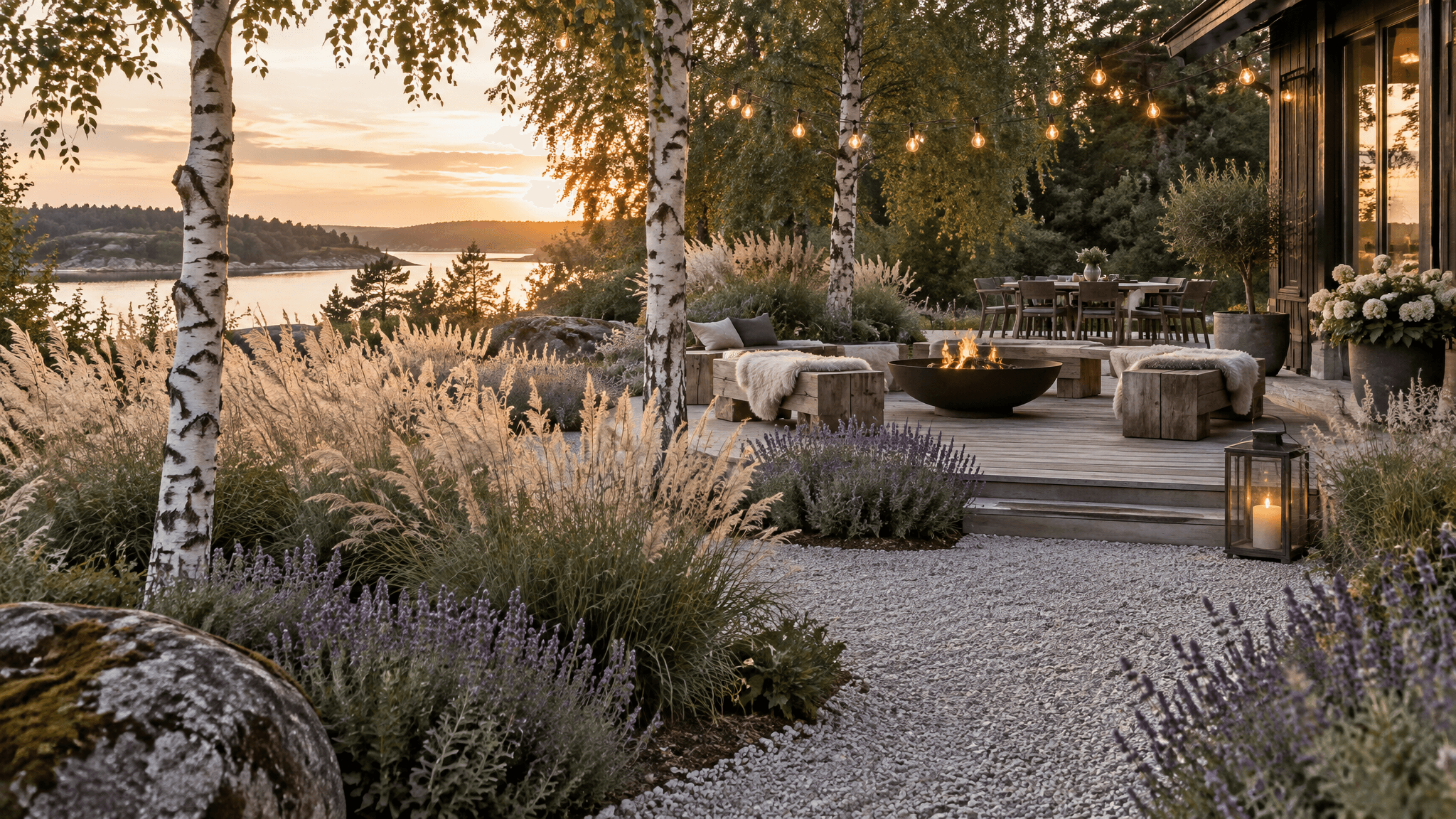
You can also compare it with related approaches: Scandinavian for a cooler, Nordic interpretation of clean-line design, or Contemporary Coastal for a relaxed take on modernist outdoor living.