An outdoor kitchen is no longer a luxury reserved for sprawling estates with six-figure landscaping budgets. In 2026, modular kits, weather-rated appliances, and smarter material choices have made it possible to build a genuinely functional cooking space outside for the price of a decent indoor kitchen renovation — and in some cases, for the cost of a good grill alone.
But the range is enormous. You can spend $3,000 on a prefab island with a cart, or $80,000 on a fully roofed, plumbed, and lit outdoor entertaining space with a pizza oven, kegerator, and built-in sound system. The right answer depends on how you actually cook, how often you entertain, and what your yard can support.
These eight designs span the full spectrum — from a minimal grill station to a complete resort-level kitchen — with real cost ranges, material recommendations, and honest notes on what is worth the money and what is not.
1. The Minimal Grill Station ($3,000 – $5,000)
This is the entry point, and it is more capable than most people expect. A prefab modular island from a brand like Bull, Blaze, or RTA Outdoor Living gives you a built-in grill cutout, stainless storage doors, and a countertop — all in a weather-resistant shell that arrives flat-packed and assembles in an afternoon.
Pair the island with a quality freestanding grill you already own (or pick up a solid Weber or Char-Broil for $400–$800), add a small stainless prep cart ($80–$150) on one side, and you have a legitimate outdoor kitchen that handles burgers, steaks, vegetables, and everything in between.
What you get: Built-in grill, 3–4 feet of counter space, basic storage, portability.
What you skip: No plumbing, no refrigeration, no shade — you are cooking in the sun with a cooler nearby.
Best for: Casual cooks, apartment-to-house first-timers, renters with large patios, anyone who wants to test the concept before committing to a permanent build.
2. The Galley Line ($5,000 – $10,000)
The galley layout borrows from professional restaurant kitchens: everything in a single line, within arm's reach. A 6-to-8-foot run of countertop with a built-in grill at center, storage below, and a small under-counter fridge at one end is the most space-efficient outdoor kitchen you can build — and it fits against a fence, a house wall, or the edge of a patio without consuming usable yard space.
The materials matter here. Concrete countertops ($50–$100 per square foot installed) are the sweet spot for this budget — customizable, durable, and modern-looking. Pair them with stacked stone or stucco facing on the base, and the result looks far more expensive than it is.
What you get: Grill, 6–8 feet of prep surface, under-counter fridge, storage, a clean linear footprint.
What you skip: No sink (no plumbing run required), limited entertaining capacity for large groups.
Best for: Small-to-medium patios, modern minimalist landscapes where clean lines matter, cooks who want efficiency over spectacle.
3. The L-Shaped Entertainer ($10,000 – $20,000)
This is where outdoor kitchens start to become real cooking and entertaining spaces. The L-shape creates a natural work triangle — grill on one arm, prep and sink on the other, with a corner that anchors the layout — while the open side faces guests, the yard, or a dining table.
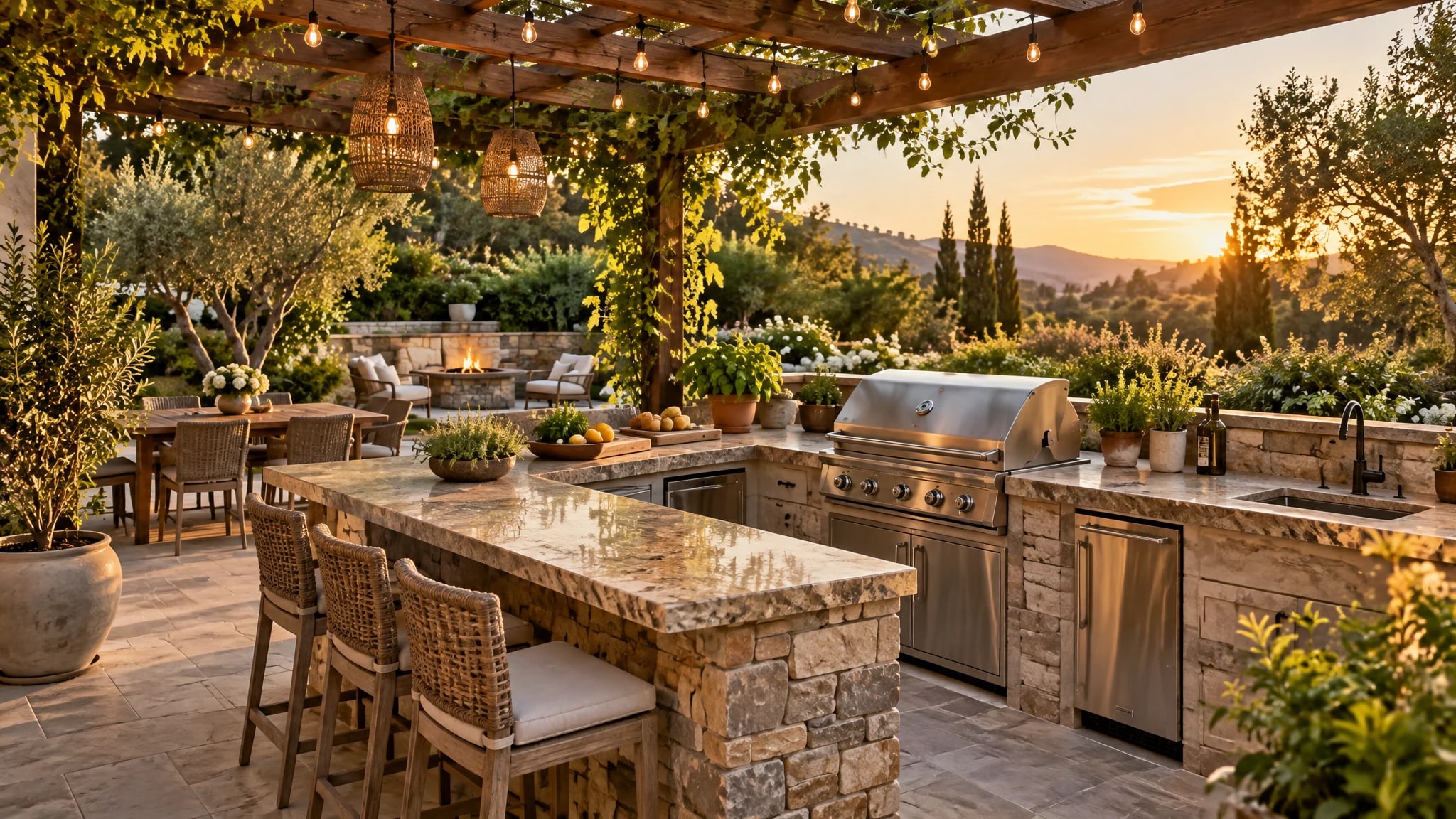
At this budget, you can afford a proper sink with running water (budget $1,500–$3,000 for the plumbing run from the house), a full-size outdoor-rated refrigerator ($800–$1,500), and upgraded countertops in granite or polished concrete. The base can be built from concrete block with stone veneer or stucco finish — both are weather-resistant and look premium.
Add a simple bar overhang on one arm of the L, and suddenly you have a spot where guests can sit on stools and talk to the cook while dinner comes together. That social dynamic is the real reason people build outdoor kitchens — it is not about the grill, it is about the gathering.
What you get: Grill, sink with running water, fridge, 10–12 feet of counter, bar seating for 2–3 people.
What you skip: No permanent shade structure, no specialty appliances (pizza oven, smoker).
Best for: Regular entertainers, families who eat outside three or more times a week, farmhouse-modern style yards with room for a dedicated cooking zone.
4. The U-Shaped Command Center ($20,000 – $35,000)
The U-shape is the most efficient layout in kitchen design, indoors or out. Three sides of countertop create an enclosed workspace where everything is within two steps — grill behind you, sink to your left, prep surface to your right. You never have to carry a raw chicken across open ground to reach the cutting board.
At this price point, materials step up significantly. Granite countertops ($100–$150 per square foot installed) are the standard, with quartzite ($120–$200) gaining ground for its superior UV and heat resistance. The base structure can be built from steel frame with stone veneer or poured concrete with a polished finish.
This is also where shade becomes non-negotiable. A louvered pergola ($3,000–$8,000) or fixed roof extension covers the cooking area, protects appliances from rain and UV damage, and extends your usable cooking season from 4–5 months to 10+ in most climates.
What you get: Full grill + side burner, sink, fridge, 14–18 feet of counter, pergola or shade structure, potentially a built-in smoker or warming drawer.
What you skip: Still a single cooking fuel (gas or charcoal, not both), no entertainment electronics.
Best for: Serious home cooks, households that entertain 20+ guests regularly, properties with dedicated patio zones that need a functional anchor.
5. The Pizza Oven Build ($25,000 – $45,000)
Pizza ovens are the most-requested premium upgrade in outdoor kitchen design — and the appliance most likely to go unused. A built-in wood-fired oven takes 30 to 60 minutes to preheat to 800°F, holds heat poorly without proper insulation, and requires genuine live-fire skill to operate well. If you make pizza at home weekly right now, a built-in oven is absolutely worth it. If you do not, buy a portable Ooni Karu ($400) first and test your commitment.
That said, when a pizza oven is used, it transforms the entire outdoor cooking experience. It is not just a pizza machine — it roasts vegetables, bakes bread, chars steaks at temperatures your gas grill cannot reach, and creates a theatrical centerpiece that pulls guests in like a campfire.
The build itself typically adds $3,000–$8,000 on top of a mid-range kitchen, depending on whether you choose a modular insert (Alfa, Forno Bravo) or a custom-built brick oven. The oven needs its own ventilation clearance, a reinforced countertop to support the weight (300–600 lbs), and a landing zone for peels and hot pans on both sides.
What you get: Everything in the U-shape plus a built-in pizza oven, upgraded ventilation, and expanded counter space for bread and pizza prep.
What you skip: This is a single-focus upgrade — if you would rather have a kegerator, bar, and TV, skip this and go to design #6.
Best for: Passionate home cooks who bake weekly, Italian-food enthusiasts, families who want a wood-fire focal point for gatherings.
6. The Bar and Lounge Kitchen ($30,000 – $50,000)
If your outdoor kitchen is more about the party than the cooking, this is the design that delivers. The layout wraps a standard L- or U-shaped kitchen with a raised bar counter on the guest-facing side, backed by a beverage center (kegerator, wine fridge, or cocktail station), an outdoor-rated TV, and built-in speakers.
The bar counter should be at 42-inch height with a 12-to-15-inch overhang for comfortable knee clearance — standard bar dimensions that work with any commercial outdoor bar stool. Under-counter LED lighting turns it into a legitimate cocktail bar after dark.
The entertainment electronics add $2,000–$5,000 to the build: a weatherproof 55-inch TV ($1,000–$2,500), outdoor-rated speakers ($300–$1,000), and a kegerator or beverage fridge ($500–$1,500). All need GFCI-protected electrical circuits run to the island — budget $800–$1,500 for the electrician.
What you get: Full kitchen plus raised bar seating for 4–6, beverage center, TV, speakers, ambient lighting.
What you skip: The cooking setup is standard (no pizza oven or specialty appliances) — the budget goes to entertainment.
Best for: Social entertainers, sports fans, anyone whose backyard is the neighborhood gathering spot.
7. The Covered Kitchen Pavilion ($45,000 – $70,000)
A permanent roof structure changes everything. It protects appliances from rain, UV, and temperature swings — extending the lifespan of a $3,000 grill from 5–8 years to 12–15+. It blocks direct sun so the cook is not miserable in July. It enables ceiling fans, recessed lighting, and hanging pendant fixtures that make the space usable and atmospheric after dark. And it turns a four-month cooking season into a ten-month one in climates from the Pacific Northwest to the Mid-Atlantic.
The structure itself — a gable-roof pavilion on timber or steel posts — runs $8,000–$20,000 depending on size, materials, and whether it is attached to the house or freestanding. Attached structures are cheaper but may require a structural engineer and a building permit. Freestanding pavilions are easier to permit but need their own footings.
Under the roof, you get a fully equipped kitchen: premium grill (Lynx, Wolf, or DCS — $3,000–$7,000), pizza oven or smoker, sink, dishwasher ($1,500–$2,500 outdoor-rated), full fridge, and 18–24 feet of quartzite or granite countertop. Ceiling fans and a natural gas connection for a fire pit or patio heater extend the season into shoulder months.
What you get: Weather-protected, year-round outdoor kitchen with premium appliances, full plumbing, electrical, lighting, and ceiling fans.
What you skip: Not much — this is a near-complete outdoor room. The next tier adds mostly size and luxury finishes.
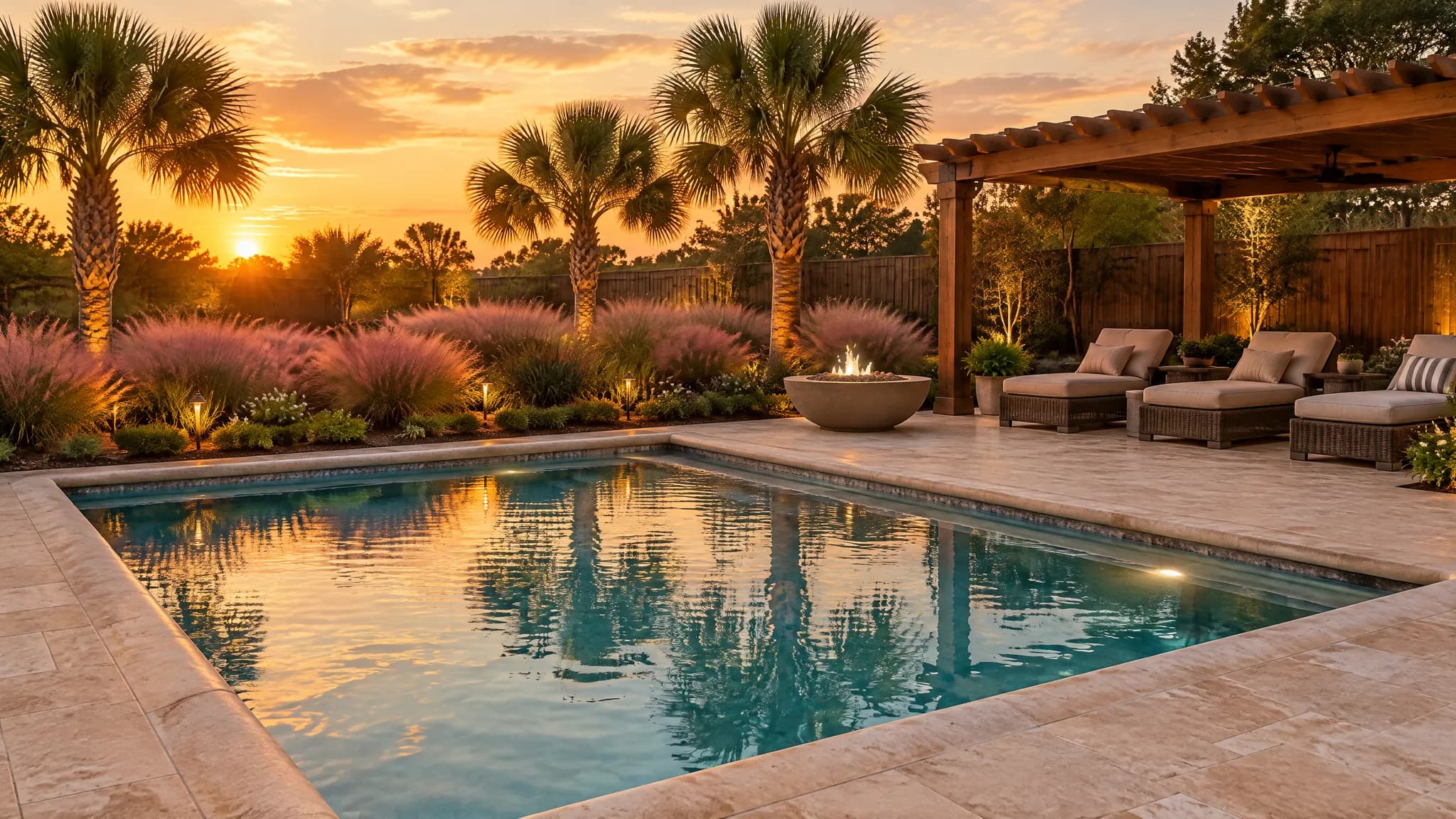
Best for: Homeowners in wet or extreme climates (Pacific Northwest, Northeast, Gulf Coast), anyone who wants appliance longevity, and serious cooks who will use the space 100+ times per year. Pairs beautifully with a tropical resort-style backyard.
8. The Resort-Style Outdoor Kitchen ($70,000 – $100,000+)
This is the full vision: a magazine-cover kitchen that functions as a complete outdoor room with restaurant-grade equipment, custom cabinetry, premium natural stone, and every comfort feature short of air conditioning. Two cooking zones — one for grilling and smoking, one for pizza or wok cooking — allow two cooks to work simultaneously without collision.
Custom stainless-steel cabinetry with soft-close drawers, built-in ice makers, warming drawers, and multiple refrigeration zones (separate beverage, wine, and ingredient fridges) make this a kitchen where you can host a multi-course dinner for 20 without going inside once. Marine-grade 316 stainless steel is mandatory for coastal properties — standard 304 stainless corrodes within three years in salt air.
The surrounding landscape is integral to the design. A mature shade tree, built-in planters with ornamental grasses, landscape lighting on the pathway from the house, and a fire feature (fire pit or linear gas fireplace built into the bar counter) create the full resort experience.
What you get: Dual cooking zones, custom cabinetry, multiple refrigeration, dishwasher, ice maker, full entertainment system, landscape lighting, fire feature, premium roof structure.
What you skip: Nothing — this is the complete package. The only variable is size and the specific appliance mix.
Best for: Large properties, dedicated entertainers, homeowners who view the outdoor kitchen as a permanent home investment. Consider our landscape design tool to visualize how a resort-level kitchen integrates into your yard.
Choosing the Right Design: A Quick Decision Framework
Before you pick a number from the list above, answer three questions honestly:
How often will you actually cook outside? If the answer is "a few times in summer," start with design #1 or #2 and upgrade later. If you are outside grilling three times a week already and wishing you had more counter space, jump to #3 or #4.
How many people do you typically host? Cooking for four requires far less infrastructure than cooking for fifteen. If you regularly feed crowds, invest in counter space, multiple cooking surfaces, and bar seating before you invest in specialty appliances.
What does your climate demand? In Phoenix, shade is not optional — it is the first line item. In Seattle, a roof structure is the difference between using the kitchen eight months a year and three. In coastal Florida, every metal surface needs to be marine-grade. Climate should shape the build before style does.
What Materials Hold Up Best Outdoors
Not all kitchen materials survive outside. Here is what works, ranked by longevity:
- Countertops: Quartzite and granite are the gold standard — UV-stable, heat-resistant, and naturally weatherproof. Concrete is excellent at mid-range budgets but needs sealing annually. Tile is affordable but grout lines trap grime and crack in freeze-thaw climates.
- Cabinetry: Marine-grade polymer (HDPE) or powder-coated stainless steel. Wood looks beautiful under a roof but deteriorates rapidly in exposed locations.
- Base structure: Concrete block with stone veneer or stucco is the most common. Steel frame is lighter and faster to build. Avoid standard lumber framing — it rots, attracts termites, and voids most appliance warranties.
- Flooring: Porcelain pavers, natural flagstone, or stamped concrete. Avoid polished surfaces that become dangerously slick when wet.
Final Thought: Start Lean, Expand Smart
The most common outdoor kitchen regret is not building one — it is building too much, too fast, and discovering that half the appliances go unused. Modular systems exist precisely for this reason. Start with a grill, counter, and storage. Cook on it for a full season. Then add the fridge, the sink, the pizza oven — each one earning its place through actual use rather than catalog fantasy.
Your backyard is not a showroom. It is a place where food brings people together, where summer evenings stretch longer because nobody wants to go inside, and where a simple meal cooked over live fire tastes better than it has any right to. The kitchen that serves that purpose — whether it costs $3,000 or $80,000 — is the right one.
Ready to see how an outdoor kitchen fits into your yard? Upload a photo of your space and visualize the transformation in seconds — free to try.