A small garden is not a limitation — it is an editing challenge. When you only have 200 or 500 square feet to work with, every plant, every paver, and every piece of furniture earns its place or gets cut. The result, when done well, is a space that feels more intentional, more immersive, and paradoxically more spacious than many large yards ever manage.
The biggest mistake homeowners make with a small garden is trying to shrink a big-yard plan. That means cramming a full lawn, a patio, a border, and a path into a rectangle that cannot support any of them at a usable scale. The better approach is to design for the constraint — to use the intimacy, the enclosure, and the close-range viewing angle as strengths rather than problems.
These ten ideas are drawn from the latest 2026 design trends and time-tested professional techniques. Each one works independently, but the real magic happens when you combine two or three in the same space.
1. The Botanical Bento Layout
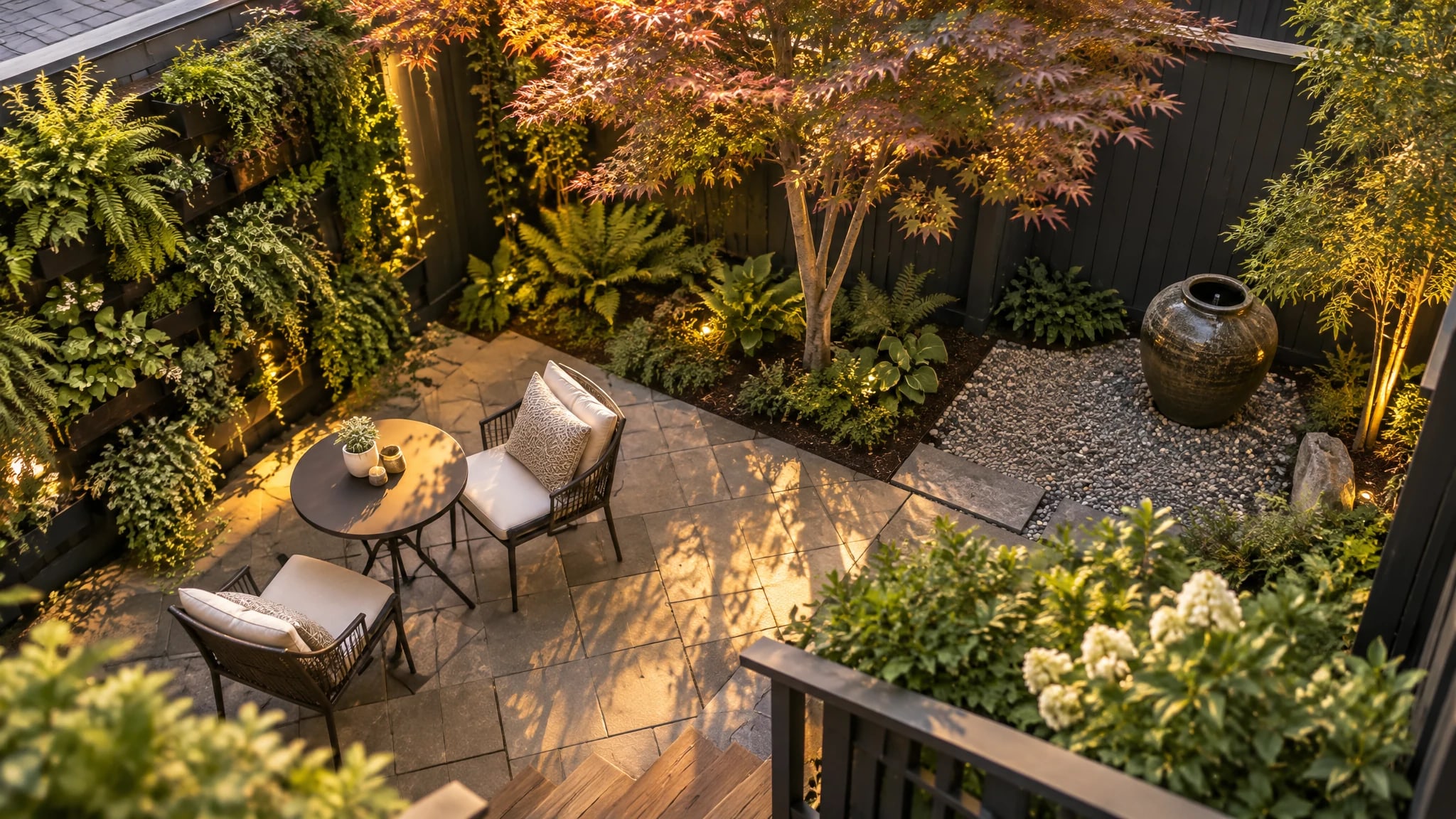
The biggest small garden trend of 2026 is the Botanical Bento — borrowed from the Japanese lunchbox concept where every compartment has a clear purpose. Instead of treating your yard as one undifferentiated rectangle, divide it into three to five distinct zones: a seating pocket, a planting bed, a gravel meditation corner, a vertical herb wall, and a stepping-stone path connecting them.
The psychology is powerful: multiple defined rooms trick the brain into perceiving a larger, more complex space than a single open area. Even in a 10-by-15-foot courtyard, three clearly bordered zones — separated by low edging, a change of surface material, or a single step up — create the feeling of moving through a garden rather than standing in one.
How to start: Sketch your space on graph paper and draw three rectangles of different sizes. Assign each one a single function. Use a different ground material for each zone — pavers for dining, gravel for planting, timber decking for lounging.
2. Diagonal Paving
This is the single most effective spatial illusion in garden design, and it costs nothing extra. The diagonal line is the longest line in any rectangle. When you lay paving, decking, or gravel on a 45-degree angle rather than parallel to the fence, the eye follows that extended line and the garden feels measurably wider.
Professional designers use this trick constantly in courtyard projects. Pair diagonal paving with a focal point — a large pot, a small tree, or a sculptural stone — placed at the far diagonal corner, and the eye travels the maximum possible distance across the space.
Cost: Same as straight paving — it is a layout decision, not a material upgrade.
3. Vertical Planting Walls
When ground space is tight, the only direction left is up. A vertical garden wall mounted on a fence or blank wall adds square footage of green without consuming a single inch of floor space. Options range from modular pocket planters ($50–$200) to full living wall systems with integrated irrigation ($500–$2,000+).
The visual impact is disproportionate to the cost. A 4-by-6-foot living wall filled with ferns, trailing ivy, and flowering calibrachoa creates more visual density than an entire ground-level border — and it is visible from every angle in a small space, including from inside the house through windows.
Best plants for vertical walls: Boston fern, creeping jenny, trailing rosemary, sedum, heuchera, and small ornamental grasses.
4. One Statement Tree
It sounds counterintuitive — why would you plant a tree in an already small space? Because a single well-chosen tree does three critical things: it adds vertical scale that lifts the eye upward, it creates dappled shade that makes the ground level feel cooler and more enclosed, and it provides a canopy ceiling that defines the space as a room rather than a patch.
The key is choosing the right tree. You want a narrow canopy, clean branching habit, and a mature size that fits the space. Japanese maple (Acer palmatum), ornamental pear (Pyrus calleryana 'Cleveland Select'), or multi-stem serviceberry (Amelanchier) are all excellent small-garden trees that stay under 20 feet with moderate spread.
Placement tip: Position the tree off-center, roughly one-third of the way across the space, to create an asymmetric composition that feels natural rather than planted.
5. The Hide-and-Reveal Technique
A garden you can see entirely from the back door feels exactly as small as it is. But obscure one section — with a tall ornamental grass, a freestanding trellis, or even a half-height hedge — and suddenly there is mystery. The visitor has to move through the space to discover what is around the corner, and that journey makes the garden feel twice its actual size.
This technique works in gardens as small as 150 square feet. A single clump of Miscanthus giganteus (8 feet tall, 4 feet wide) placed at the midpoint of a narrow garden creates two distinct rooms from one. You do not need a maze — just one visual break is enough to transform the experience.
Budget option: A simple cedar trellis ($30–$80) with climbing jasmine or clematis creates an instant screen within one growing season.
6. Mirror Illusions
Strategic mirrors are a classic small-space trick borrowed from interior design. A weather-resistant garden mirror mounted on a fence or wall reflects greenery, light, and depth — visually doubling the perceived space in that direction. The effect is strongest when the mirror is partially obscured by planting, so the reflection blends seamlessly with the real garden.
Placement rules: Mount the mirror at a slight angle so it reflects plants and sky, not the viewer directly. Frame it with climbing plants to disguise the edges. Use acrylic garden mirrors rather than glass for safety — they are lighter, shatterproof, and weather-rated.
Cost: $40–$200 for a quality outdoor mirror.
7. Fewer, Larger Containers
The most common small-garden clutter comes from a collection of twelve little pots, each with a different plant, scattered across every surface. It looks busy, fragmented, and ironically makes the space feel smaller.
The professional fix is dramatic: replace all those small pots with two or three large-scale containers (18 inches or wider). A single oversized pot with a structural plant — a dwarf olive tree, a large agave, or a cloud-pruned boxwood — creates more impact than a dozen small ones. The visual weight of fewer, bolder elements calms the space and lets the eye rest.
Budget approach: Concrete cylinder planters are $30–$80 each and look far more expensive than they are. Group three in descending sizes for a modern, cohesive arrangement.
8. Multi-Level Elevation Changes
Flat gardens feel flat. Adding even a single 6-inch step-up — a raised timber deck, a stone platform, or a sunken gravel seating area — introduces a vertical layer that makes the space feel more complex and three-dimensional. In a small garden, elevation changes function like room dividers in an open-plan apartment: they define zones without walls.
A raised deck at the back of the garden with a lower gravel area in front creates two distinct levels that read as separate spaces. Add a third level — a single step down to a small planting bed — and you have a garden that feels like it unfolds as you move through it.
Cost: A simple 8-by-8-foot raised timber deck runs $500–$2,000 DIY, depending on materials.
9. Dark-Painted Boundaries
Paint your fence dark — charcoal, black, or deep forest green — and watch it visually recede. Light-colored fences reflect light and draw attention to themselves, making the boundary feel close and prominent. Dark boundaries absorb light and disappear into shadow, creating the illusion that the garden extends further than it actually does.
This is one of the cheapest and most effective transformations you can make. A gallon of exterior paint is $30–$50 and covers an average small-garden fence in an afternoon. The planting in front pops dramatically against a dark backdrop — green foliage, white flowers, and variegated leaves all look more vivid.
Pro tip: Extend the dark paint to include any walls, sheds, or structures at the boundary line. Consistency is key — one dark envelope wrapping the entire perimeter creates maximum depth.
10. Smart Lighting for Evening Scale
A small garden that is only usable during daylight is half a garden. Strategic low-voltage lighting extends the usable hours and, more importantly, reshapes the perceived space after dark. Uplighting on the tree canopy draws the eye upward. Path lights along the diagonal axis emphasize length. A warm pendant or string light over the seating zone creates a ceiling effect — an intimate outdoor room within the larger darkness.
The 2026 approach is layered: ground-level path markers, mid-height accent lights on plants and walls, and overhead ambient light over seating. All warm white (2700K), all on a single smart controller or timer.
Cost: A basic low-voltage LED landscape lighting kit starts at $100–$300. Professional installation for a small garden runs $500–$1,500.
Putting It All Together
The most effective small gardens combine three or four of these techniques in a single cohesive design. A typical high-impact combination:
- Diagonal paving for the ground plane — extends perceived width
- One statement tree for vertical structure — lifts the eye and creates canopy
- Dark-painted fence as backdrop — boundaries recede
- Two large containers as focal anchors — visual calm
- Vertical planting wall on the sunniest fence — green density without floor space
The total cost for this combination? As little as $500 DIY or $2,000–$5,000 with professional materials. The perceived space gain is dramatic — visitors consistently guess these gardens are 30–50% larger than they actually are.
Visualize Before You Build
Not sure which combination works for your space? Upload a photo of your small garden to our AI garden design tool and see multiple layout options rendered on your actual yard — different paving angles, tree placements, vertical planting arrangements, and color schemes — before you spend a dollar or lift a shovel.