A good pool does not make a resort. The space around it does: the deck that stays comfortable at 3 p.m., the planting that frames the water without dropping leaves into the skimmer, the shade you can actually sit under, and the lighting that makes the whole thing glow after dark. Most of the money, and most of the mistakes, are in that surrounding landscape.
These 15 pool area landscaping ideas are ordered the way a project actually unfolds: safety and surfaces first, then planting, then the structures and lighting that turn a pool into a place. Costs are 2026 national averages from published guides, so treat them as planning ranges and get local quotes before you commit.
Start With the Ground and the Barrier
1. Design the safety barrier as part of the layout
The U.S. Consumer Product Safety Commission recommends a fence at least 4 feet high around the pool, with 5 feet or higher preferred. A fence that completely surrounds the pool is better than one that uses the house as the fourth side, and pedestrian gates should open away from the pool and be self-closing and self-latching. The same guidance says barriers should be placed so children cannot use permanent structures, equipment, or similar objects to climb them.
That last point is a design rule, not just a safety footnote. Keep planters, lounge chairs, and the fire bowl away from the fence line, and choose a handsome slatted or glass-panel barrier you will not want to hide. Check local code too, since requirements vary.
2. Pick a deck that stays cool underfoot
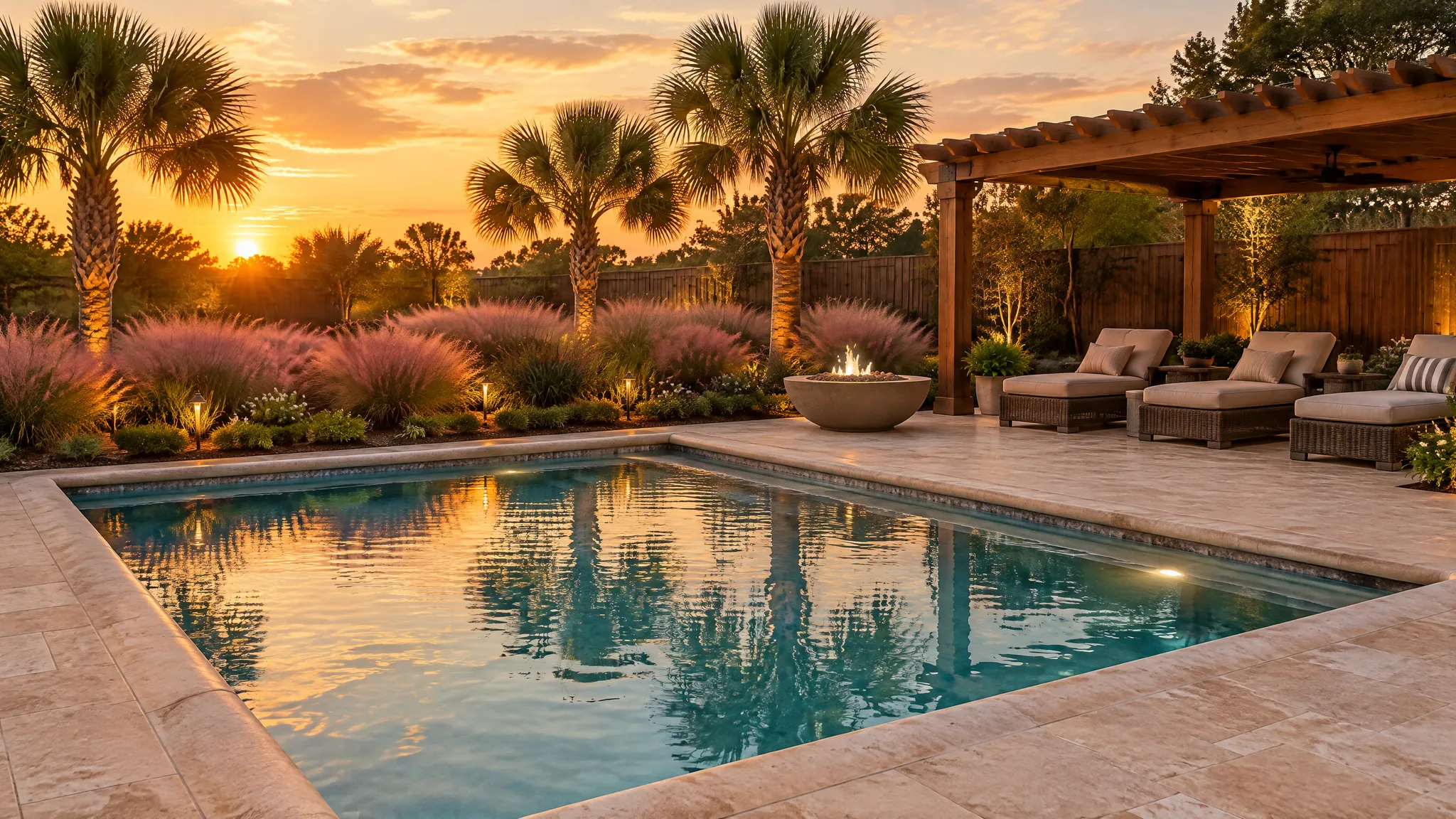
Color does most of the work. Light, textured surfaces absorb less heat than dark or smooth ones. One Texas pool builder's published readings in full summer sun put light travertine around 105–115°F, medium concrete pavers at 120–135°F, light brushed concrete at 130–140°F, and dark stamped concrete above 150°F. Exact numbers vary by region, but the order is consistent across the sources we checked.
HomeGuide puts travertine pool decks at roughly $13–$30 per square foot installed, plus $1–$3 per square foot to seal it. A paver patio runs about $10–$17 per square foot and poured concrete $5–$15. Choose tumbled or brushed finishes rather than polished stone so wet feet keep their grip.
3. Finish the edge with real coping
Bullnose travertine coping runs about $20–$40 per linear foot installed. It is a small line item that changes how the whole pool reads, because the edge is the first thing the eye lands on. A coping in a slightly deeper tone than the deck gives the water a clean outline.
4. Pay for drainage you will never see
Most pool deck projects need proper grading so water sheds away from the pool and the house. HomeGuide lists drainage grading at about $500–$1,500. Skipping it is how a beautiful deck ends up with puddles, algae, and heaved pavers within a few seasons.
Plant for Splash, Not Just Looks
5. Build a splash zone with tough, low-litter plants
Beds within a few feet of the coping take heat reflected off the deck, chlorinated splash, and sometimes salt. Pink muhly grass (Muhlenbergia capillaris) is a good anchor: Clemson's Home & Garden Information Center rates it zones 7–10, tolerant of salt spray, and very drought tolerant once established. Cut it back to the ground in early spring before new growth starts.
Trailing lantana (Lantana montevidensis) spills over edges and is hardy in zones 8–10. NC State Extension notes it tolerates salt spray, root-hardy in zone 8 if mulched, and its seeds are spread by wildlife, so cut it back if it wanders. In colder zones, treat it as an annual.
6. Use palms for the silhouette
Palms give the resort look with fewer problems than most trees. University of Florida horticulturist Edward Gilman notes that palms can be planted closer to pools because their roots are not aggressive and their canopies do not spread far. Windmill palm (Trachycarpus fortunei) is among the hardiest, rated zones 8a–11 by UF/IFAS and able to handle temperatures near 10°F, and NC State lists it for zones 7–11. Mediterranean fan palm (Chamaerops humilis) is hardy to about zone 7b according to Mississippi State Extension. University of Arizona Extension suggests keeping fronds pruned and removing flowers before seeds set to cut down litter.
7. Keep real trees at a distance
UF/IFAS gives a simple spacing rule: plant trees at least 10 feet from the pool wall, medium-maturing trees at least 20 feet away, and large trees at least 30 feet away. That keeps leaves and fruit out of the water and roots away from the shell and plumbing. Soft-fruited trees should be far enough back that the canopy will not drop fruit on the deck. Conifers are especially sensitive to chlorine fumes on hot days, and the foliage can be permanently damaged.
8. Choose low-water plants and plant the messy ones downwind
Arizona Extension's pool planting advice is practical: pick plants with minimal litter or ones that drop all their leaves at once so you only clean up once a year, choose low-water-use plants because too much irrigation can damage decking and equipment, and plant anything with seasonal litter downwind of the pool. Mass a few species in drifts rather than one of everything. The pool is the star, so the planting should read as a calm frame.
Pick a Style and Commit to It
9. Mediterranean courtyard pool
Olive trees, lavender, terracotta, and flagstone suit a pool because they like heat and sharp drainage. Olive (Olea europaea) is rated zones 8–10 and needs full sun, and English lavender wants 6–8 hours of sun and neutral to slightly alkaline soil. Our Mediterranean garden guide covers the plant list, hardiness limits, and what to do in colder zones. In cold climates, keep the olive in a pot you can move.
10. Tropical resort pool
Layers of palms, large-leaf foliage, and a freeform pool make the strongest first impression. The tropical resort style leans on bold texture and dense planting, and our own tropical pool makeover shows how far a bare yard can travel. Outside warm zones, keep tender plants in containers and put hardy palms in the ground.
11. Modern coastal or minimalist pool
If you want calm rather than lush, use one deck material, a narrow planting palette, and clean lines. A contemporary coastal pool area pairs pale stone with grasses and weathered wood. Fewer plant species also means fewer things dropping into the water.
Add the Structures That Make It Livable
12. Shade you can sit under
A pergola over a lounge area brings shade without walling off the pool. HomeGuide lists prefab pergola kits at about $1,450–$5,750 installed and custom wood pergolas at $4,300–$9,350. Aluminum and vinyl cost less for materials than cedar or redwood. Plan the pergola footings before the deck is poured, because cutting into a finished deck is expensive.
13. Add a fire feature, with the right clearances
HomeGuide puts professionally installed gas fire pits at $3,500–$8,000, propane fire pits at $900–$2,000, and wood-burning pits at $500–$6,000. It recommends keeping a gas unit at least 10–15 feet from the house and a wood-burning one 15–30 feet away, on a level, fire-resistant surface with no trees overhead. Manufacturer manuals add overhead clearance: one burner-kit manual calls for 84 inches of open space above units up to 200,000 BTU, so if a pergola will sit over the fire bowl, check the unit's label and your local code first.
14. Light it in layers
Low-voltage LED lighting is the budget-friendly way to extend pool season into the evening. HomeGuide lists installed low-voltage fixtures at $100–$150 each, a transformer at $200–$500 installed, and trenching at $5–$12 per linear foot. Angi notes LEDs use up to 80% less electricity than halogen. Light the palm trunks and the planting beds from below, mark steps and paths, and keep the brightest light inside the water. If an LED pool light needs replacing, HomeGuide quotes $600–$1,500 each installed.
15. Give the pool a destination
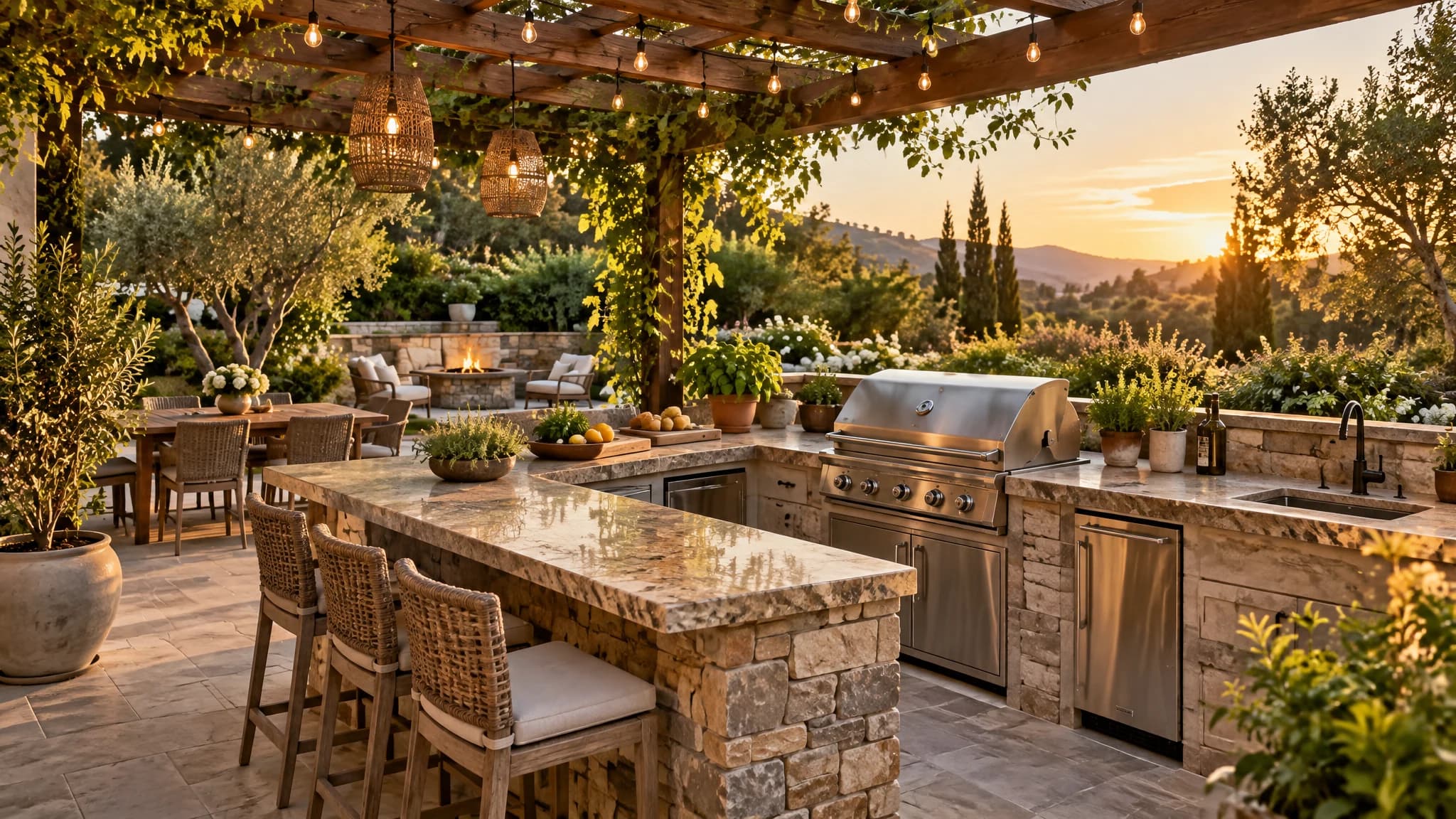
A cabana, daybed pavilion, or outdoor kitchen is what keeps people at the pool all afternoon. HomeAdvisor's averages are about $4,000 for a pool shed and $15,000 for a cabana. If entertaining is the goal, our guide to outdoor kitchen designs for every budget breaks down what each tier costs and which appliances are worth it.
What to Avoid Around the Water
- Thorny or spiny plants near walkways. Brushing past agave or yucca in a swimsuit is a bad time. Keep them back from the path.
- Large-leaf deciduous trees near the coping. Big leaves clog skimmers and fine debris reaches the pump.
- Heavy irrigation next to the deck. Overwatering damages decking and equipment.
- Polished stone. It looks great dry and is slick when wet.
- Plants you cannot reach for pruning. Palms and tall grasses still need an annual cut-back.
A Realistic Budget Order
If you cannot do everything at once, spend in this order: barrier and drainage, then deck surface and coping, then planting, then shade, then lighting, then the fire feature and cabana. The first group is hard to change later. The last group can be added one piece at a time without tearing anything up.
Not sure which direction fits your yard? Upload a photo of your pool area and preview resort-style layouts in seconds, free to try.
Sources
Costs and plant facts were checked in October 2026. Prices are national averages and vary by region; surface temperatures are one builder's published readings.
- U.S. CPSC — Safety Barrier Guidelines for Residential Pools
- UF/IFAS (Edward Gilman) — Special planting situations: swimming pools
- University of Arizona Extension — Landscaping around your pool (az1058)
- HomeGuide — Travertine pavers cost (2026), pool deck and coping pricing
- HomeGuide — Pool deck cost (2026), patio material pricing
- Simplified Pools — Pool deck options compared (surface temperatures)
- Clemson HGIC — Muhlenbergia capillaris (muhly grass)
- NC State Extension — Lantana montevidensis (trailing lantana)
- UF/IFAS — Windmill palm (Trachycarpus fortunei)
- NC State Extension — Trachycarpus fortunei
- Mississippi State Extension — Cold injury to palms (Chamaerops humilis zone 7b)
- Missouri Botanical Garden — Olea europaea (zones 8–10)
- Utah State University Extension — English lavender in the garden
- HomeGuide — Pergola cost (2026)
- HomeGuide — Fire pit cost (2026), placement and clearances
- HPC Fire — Fire pit burner kit safety manual (overhead clearances)
- HomeGuide — Landscape lighting cost (2026)
- HomeGuide — Pool light replacement cost (2026)
- Angi — Landscape lighting costs (LED efficiency)
- HomeAdvisor — Cost to build a pool house
- PoolChecker — Pool deck materials guide (tumbled or brushed finishes, never polished)
- In The Swim — Best and worst trees to plant around a pool