Art Deco interior design is the style that refuses to whisper. Born in the 1920s from a collision of Cubist geometry, machine-age optimism, and an unapologetic love of luxury materials, it has outlasted every wave of minimalism that tried to retire it. In 2026, the movement is back with a sharper edge — rebranded by designers and trend forecasters as Neo Deco — and it is dominating everything from Pinterest boards to the showrooms of Salone del Mobile in Milan. The difference between the original and the revival is one of editing: where Jazz Age interiors piled on gilding, chevrons, and exotic veneers until a room trembled under the weight of its own ambition, Neo Deco keeps the geometry and the glamour but strips away the excess. The result is a style that feels both dramatic and livable — rich enough to make a statement, restrained enough to inhabit daily.
This guide covers the philosophy that powers Art Deco interior design, the exact materials and color decisions that define it in 2026, the furniture principles that separate a genuine Deco room from a merely gold-accented one, and room-by-room strategies for executing the style from scratch. Whether you are designing a full home or editing a single room, these are the decisions that matter.
From the Jazz Age to Neo Deco: A Century of Geometry
Understanding Art Deco requires understanding the era that produced it. The style emerged in Paris in the 1920s, officially debuted at the 1925 Exposition Internationale des Arts Décoratifs et Industriels Modernes, and spread rapidly through New York, Shanghai, Mumbai, and Buenos Aires. It was the first truly global decorative style, and it drew on everything from Egyptian pharaonic geometry to Aztec stepped forms to the machine aesthetic of the industrial age. The unifying idea was that decoration should not apologize for itself — that geometric pattern, luxurious materials, and dramatic contrast were not superficial indulgences but expressions of modernity and confidence.
The original movement faded after World War II, giving way to mid-century modernism's stripped-down functionalism. But Art Deco never truly disappeared. It surfaced in the Hollywood Regency style of the 1960s, the postmodern interiors of the 1980s, and the boutique hotel aesthetics of the 2010s. The 2026 Neo Deco revival, identified by Pinterest Predicts as a defining trend and confirmed at Milan Design Week, takes the strongest elements of the original — geometric boldness, rich materiality, dramatic symmetry — and applies them with a modern hand. As designer Amy Pariser puts it: "Deco has always been about material richness, but in a contemporary context it's also about restraint and authenticity."
The practical implication is clear: you do not need to recreate a 1920s Parisian salon. You need to borrow Deco's structural principles — geometry that organizes space, materials that reward the eye and hand, contrast that creates drama — and execute them with the editing discipline of a contemporary designer.
The 2026 Art Deco Color Palette
Color is where Art Deco declares its intentions. This is not a neutral-safe style. The palette is deliberately dramatic, built on high contrast between deep tones and luminous metallics.
Foundation Colors
Your base sets the stage for everything else. Art Deco foundations are darker and more saturated than most contemporary styles:
- Charcoal and graphite black — the most dramatic base, used on walls, floors, or large furniture pieces to create depth and anchor metallic accents
- Ivory and warm cream — the lighter alternative, providing a canvas that lets jewel tones and brass read clearly without darkening the room
- Deep warm grey — a softer middle ground that reads sophisticated without the commitment of black
- Champagne — warmer than white, cooler than cream, with a subtle golden undertone that anticipates the brass accents above
Jewel-Tone Accents
This is the heart of the Deco palette. Each room gets one hero jewel tone — never all at once:
- Emerald green — the signature Art Deco color, equally at home on a velvet sofa, a lacquered wall, or a marble countertop
- Sapphire blue — deep, inky, and regal; the alternative to emerald for bedrooms and living spaces
- Burgundy and oxblood — the warm option, adding richness without the coolness of blue or green
- Deep teal — sits between emerald and sapphire, a versatile choice for those who want jewel-tone drama without committing to a single direction
- Cognac — warmer and more approachable, often appearing in leather accents and wood tones rather than paint or upholstery
The Metallic Rule
In Art Deco, metals function as colors, not just accents. Brass and aged gold are the defining metallics — hardware, light fixtures, mirror frames, table legs, decorative objects — appearing at every scale throughout the room. The 2026 approach mixes warm brass with selective chrome or blackened steel for a layered, contemporary feel. The key distinction: in Scandinavian or Japandi interiors, metallics are incidental. In Art Deco, they are structural.
The 60-30-10 rule applies with a Deco twist: 60% deep base tone, 30% jewel accent, 10% metallic. A room that follows this ratio will read as intentionally glamorous rather than chaotically decorated.
Materials: Where Art Deco Lives or Dies
Material choice is the difference between an Art Deco room that convinces and one that merely references the style. The original movement was built on the most luxurious surfaces available — ebony, shagreen, lacquered wood, marble, mirrored glass. The 2026 version is more accessible but equally demanding about surface quality and contrast.
The Gloss-Matte Dialogue
Art Deco thrives on the contrast between reflective and absorptive surfaces. High-gloss lacquer next to matte plaster. Polished brass against honed marble. Velvet softness beside mirrored glass. This dialogue of surfaces is what gives a Deco room its visual depth — light bounces between glossy and matte surfaces, creating a sense of movement and richness that flat finishes alone cannot achieve.
Core Materials
- Marble — veined marble for countertops, fireplace surrounds, coffee table tops, and bathroom surfaces. The bolder the veining, the more Deco the effect. Geometric marble patterns — chevron, bookmatched, or diamond-laid — push it further
- Velvet — the defining Deco upholstery fabric. Channel-tufted, button-tufted, or smooth, always in jewel tones or deep neutrals. Velvet absorbs light while brass reflects it — this contrast is the material signature of Art Deco
- Lacquer — high-gloss lacquered surfaces on cabinetry, sideboards, and accent tables. Black lacquer is classic; deep emerald or navy lacquer is the 2026 evolution
- Dark wood — walnut, mahogany, rosewood, and burl veneer in rich, dark finishes. Book-matched veneers, geometric inlays, and cerused grains are period-correct details that carry weight and warmth
- Brass and gold metals — satin brass, brushed gold, and aged bronze for hardware, frames, and fixtures. Polished chrome for a cooler, more machine-age edge
- Fluted and reeded glass — one of the strongest 2026 trends, appearing in cabinet doors, room dividers, and light fixtures. Fluted glass filters light into soft vertical lines that echo Deco's love of pattern
- Mirrored surfaces — smoked mirror panels, antiqued mirror backsplashes, and mirrored furniture contribute to the style's signature reflective depth
What to Avoid
Matte oak, raw linen, exposed concrete, and unfinished metal — the material vocabulary of Scandinavian and industrial design — work against Art Deco's fundamental commitment to polish and richness. If a surface does not reward the eye or the hand, it does not belong in a Deco room.
Furniture: Sculptural, Symmetrical, Statement
Art Deco furniture operates as spatial architecture. Each piece has a strong silhouette, a clear geometric logic, and enough material presence to hold a room. The 2026 approach balances Deco's love of bold form with modern comfort and livability.
The Geometry-Softness Balance
Classic Art Deco leaned hard into angular, stepped forms. Neo Deco softens the edges: a channel-tufted sofa with rounded arms, an arched display cabinet, a scalloped headboard. The rule from designer Clara Howell: "Always balance a clean line with a soft curve — a disc pillow on an angular sofa, or an asymmetric vase atop a square pedestal." This push-pull between geometry and softness is what keeps Neo Deco from feeling rigid.
Key Furniture Pieces
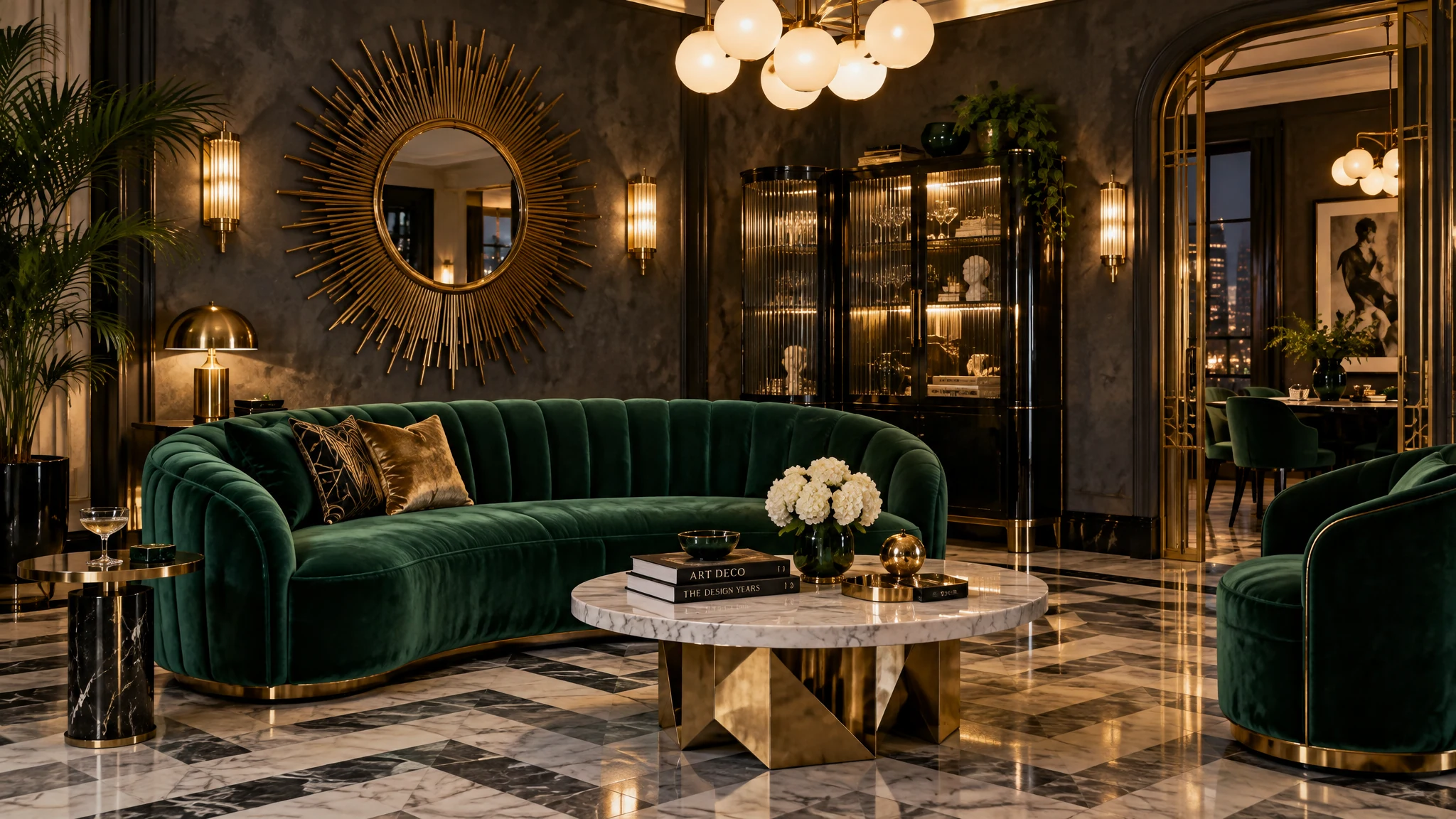
- The statement sofa — curved or channel-tufted, in emerald velvet, sapphire blue, or deep burgundy. This is the room's anchor and its largest color commitment
- Geometric coffee table — brass frame with marble or smoked glass top, often featuring stepped or tiered levels
- Lacquered sideboard — high-gloss finish with geometric brass hardware, serving as both storage and display surface
- Channel-tufted accent chair — the Deco club chair, rounded and deeply upholstered, in velvet or leather
- Sunburst mirror — the single most iconic Deco decorative element, positioned as a focal point above a console, fireplace, or bed
- Tiered or stepped side tables — brass, marble, or lacquered wood, echoing the stepped forms of Deco architecture
- Bar cart — brass and glass, a functional piece that doubles as a display of the era's cocktail culture heritage
The Symmetry Principle
Art Deco rooms are organized symmetrically. Matching table lamps flank a sofa. Identical nightstands frame a bed. A pair of accent chairs face each other across a coffee table. This bilateral symmetry creates the visual order and formality that the style demands. Asymmetric, casual arrangements — a single floor lamp, mismatched side tables — belong to other design languages.
Lighting: Drama in Every Layer
Lighting in an Art Deco interior is a design element, not a utility. Every fixture contributes to the room's geometry and material story.
The Three-Layer System
- Statement pendant or chandelier — geometric forms in brass, chrome, or opal glass. Tiered chandeliers, globe clusters, and stepped Art Deco forms serve as the room's vertical focal point
- Architectural wall sconces — fluted glass or opal globe sconces in pairs, reinforcing the symmetry principle and adding warm sidelight
- Task and accent lighting — brass picture lights over art, stepped-base table lamps on consoles and nightstands, and LED cove lighting that washes walls with warm, indirect glow
Fixture Materials
Brass, chrome, opal glass, and fluted glass are the primary fixture materials. The 2026 shift favors warmer brass over cooler chrome, but mixing both in a single room — brass pendants above, chrome sconces at wall level — adds the layered metallic contrast that Neo Deco celebrates.
The Warm-White Requirement
All bulbs at 2700K–3000K warm white. Art Deco rooms are designed around warm, golden light that makes jewel tones glow and brass shimmer. Cool-white LEDs flatten the palette and kill the mood.
Room-by-Room Application
Living Room
The living room is Deco's primary stage. Start with a charcoal or deep-toned feature wall — limewash or lacquer for texture — and place a statement sofa against it in your chosen jewel tone. A geometric brass-and-marble coffee table centers the seating area. Matching table lamps on a console behind the sofa, a sunburst mirror above, and a pair of channel-tufted accent chairs complete the symmetrical arrangement. Layer a geometric rug in complementary tones underfoot. The AI interior design tool can preview this arrangement on your actual room before you commit to a single purchase.
Bedroom
The Deco bedroom is a cocoon of controlled drama. A channel-tufted or scalloped headboard in velvet serves as the focal point — emerald, navy, or deep plum. Flanking brass or chrome table lamps on matching nightstands. A geometric mirror or sunburst piece above the bed. Dark wood furniture — a lacquered dresser, a stepped side table — completes the material story. Blackout velvet curtains in a tone that coordinates with the headboard. Keep surfaces edited: fewer objects, stronger presence.
Kitchen
Deco kitchens are less common but increasingly popular in 2026. Dark lacquered or fluted-panel cabinetry with brass hardware. Geometric marble backsplash — chevron or bookmatched. Brass bar stools at a marble-topped island. Pendant lights in geometric brass forms. The key is restraint: a kitchen that reads as sophisticated and functional rather than a period costume piece.
Bathroom
The Art Deco bathroom is where the style's love of marble and metallics finds its most natural expression. Veined marble on floors and walls in geometric patterns. Brass fixtures and hardware throughout. A sunburst or geometric mirror above the vanity. Fluted glass for shower enclosures. Sconce lighting in brass and opal glass at either side of the mirror, never overhead. This is a room where material quality matters at every touchpoint.
Dining Room
Symmetry defines the Deco dining room. A rectangular or oval table in dark wood or lacquer, centered under a geometric chandelier. Matching upholstered chairs in velvet. A lacquered sideboard against the wall with brass hardware and a mirrored top or panel. Candlestick holders in brass on the table. The dining room is where Art Deco's sense of occasion — its connection to entertaining, gathering, and celebration — comes alive most naturally.
Art Deco vs. Other Glamorous Styles
If you have been browsing luxurious interiors, here is how Art Deco compares to styles that share some of its DNA:
| Element | Art Deco / Neo Deco | Hollywood Regency | Contemporary Glam |
|---|---|---|---|
| Mood | Bold, geometric, confident | Theatrical, playful, over-the-top | Sleek, polished, understated |
| Palette | Jewel tones + black + brass | Bright colors + white + gold | Neutral + silver/chrome |
| Geometry | Chevrons, sunbursts, steps, fluting | Trellis, lattice, Greek key | Minimal, clean-lined |
| Materials | Marble, velvet, lacquer, dark wood | Lacquer, mirrored, lucite, faux fur | Glass, chrome, smooth leather |
| Symmetry | Strict bilateral | Balanced but relaxed | Flexible |
| Era reference | 1920s–1930s Jazz Age | 1950s–1960s Old Hollywood | No specific era |
Art Deco is the most architecturally structured of these styles — geometry is not just decoration but the organizing principle of the room. If you prefer a quieter take on polish, our contemporary interior design guide covers the sleeker end of the spectrum, while the traditional interior design guide explains how classic millwork and symmetry can deliver a formal look without the Jazz Age geometry.
Common Mistakes to Avoid
Going all-gold everything. Brass and gold are essential, but a room where every surface gleams reads as costume jewelry rather than design. Layer metallics against matte surfaces — velvet, plaster, honed stone — so the reflective moments have contrast to play against.
Skipping the geometry. A room with velvet and brass but no geometric pattern is Contemporary Glam, not Art Deco. The chevrons, sunbursts, stepped forms, and fluted details are what make the style Deco. Introduce geometry through at least one major element: a rug, a mirror, a cabinet front, a tile pattern.
Using too many jewel tones. The rule is one hero jewel tone per room, supported by neutrals and metallics. Emerald sofa, sapphire curtains, and burgundy chairs in the same space reads as confused rather than glamorous. Choose one and commit.
Forgetting the symmetry. Art Deco rooms are organized, not casual. Asymmetric furniture arrangements and mismatched accessories work in bohemian or eclectic spaces — they undermine the formal geometry that Deco requires.
Choosing matte over gloss. Matte finishes belong to Scandinavian and wabi-sabi interiors. Art Deco depends on the interplay between high-gloss and soft surfaces. At least one major surface — a lacquered cabinet, a polished marble countertop, a mirrored wall panel — should catch and reflect light.
The Budget Reality
Art Deco can be executed at any price point, but the material quality expectation is higher than most styles. Where Scandinavian design can succeed with IKEA-tier birch plywood, Art Deco demands surfaces that look and feel intentionally luxurious.
- Entry level ($2,000–$5,000 per room) — One statement piece (a velvet sofa or geometric mirror), brass hardware swap, a jewel-tone accent wall, and a geometric rug. Focus on one room and do it well rather than spreading thin.
- Mid-range ($8,000–$20,000 per room) — Lacquered or fluted cabinetry, marble-topped tables, quality velvet upholstery, brass lighting fixtures, and geometric tile or wallpaper on a feature wall.
- High-end ($25,000+ per room) — Custom lacquered millwork, real marble surfaces, vintage or designer Deco furniture, professional lighting design, and bespoke metalwork.
At every price point, the principle is the same: fewer pieces, better quality, stronger geometry.
Transform Your Space with AI
Ready to see how Art Deco would look in your room? Upload a photo to our AI interior design tool and apply the Art Deco style instantly — no commitment, no cost. The tool renders your space with the jewel tones, brass accents, and geometric forms that define the style, so you can preview the transformation before touching a wall.
You can also try the style transfer tool to blend Art Deco with contemporary elements, or browse our full style gallery for more design inspiration across both interior and landscape styles.