Minimalism has an image problem. Search for it and you will find white rooms with one chair and a single plant, photographed so carefully that no human could actually live there. That is not what most people want, and it is not what good modern minimalist interior design is about. At its best, minimalism is a way of making a home easier to live in: fewer things to clean, fewer decisions to make and more room for the things that matter.
This guide explains how to get that result in a real home. It covers where the style comes from, how to build a palette and choose materials, what to buy, how to approach each room, which mistakes to avoid and what it costs. If you only want a quick overview of the look, start with our modern minimalist style page. If you want a plan you can follow, read on.
Where Modern Minimalism Comes From
The style grows out of two traditions that arrived at similar conclusions from different directions. The first is European modernism of the early twentieth century. The Bauhaus school and architects such as Ludwig Mies van der Rohe argued that buildings and furniture should be honest about their structure and purpose, and that ornament added cost without adding value. "Less is more" became the movement's shorthand.
The second tradition is Japanese. Traditional Japanese homes use sliding screens, tatami mats, built-in storage and carefully framed views to create rooms that change function through the day. Empty space is not an absence there; it is part of the design. When Western architects and designers encountered this approach, it reinforced the idea that calm comes from restraint.
By the 1990s these ideas had merged into the clean-lined, neutral interiors that most people now call minimalist. Today's version is softer than the stark white boxes of that era. It uses warmer neutrals, natural materials and more texture, because most people find a room more comfortable when it has something to touch and look at.
The Core Principles
Almost every convincing minimalist room follows the same few rules, whatever its size or budget.
1. Edit before you buy
You cannot decorate your way to minimalism. The first step is deciding what stays. Go through the room by category, such as books, textiles, decor and electronics, and keep only what you use or genuinely love. Everything else is sold, donated or stored out of sight. A room with less in it needs far less styling.
2. Give every object a home
Minimalism fails when surfaces become the default storage. Plan where each category of belongings lives, preferably behind a door or inside a drawer. Built-in wardrobes, wall-hung cabinets and furniture with hidden compartments do most of the work. When there is a place for everything, tidying takes minutes.
3. Keep the palette quiet
Choose two or three base colors and stay inside them. Warm white, greige and soft charcoal are the most reliable. A single accent such as sage, clay or deep navy can appear in small doses. The less the color changes from wall to floor to furniture, the calmer the room feels.
4. Let texture do the work
Without pattern or ornament, a room needs texture to keep from feeling flat. Mix smooth and rough surfaces: a linen sofa on a wool rug, an oak table beside a plaster wall, a ceramic vase next to a matte metal lamp. Keep the colors close and vary the touch.
5. Leave space around things
Negative space is a design material. Leave part of each wall bare, avoid filling every shelf and keep a clear zone around the largest pieces of furniture. A single well-chosen artwork looks better with a wide margin than a gallery wall squeezed into the same space.
Choosing a Palette
A restrained palette is the foundation of the style, but "neutral" covers a wide range. These are three combinations that work in most homes.
- Warm neutrals — Warm white walls, greige textiles, oak or ash wood and brushed brass details. This is the friendliest option and suits rooms with limited daylight.
- Cool greys — Pale grey walls, charcoal upholstery, black metal and concrete-look surfaces. Best in bright rooms, where the cooler tones read as crisp rather than cold.
- Monochrome with one accent — Mostly white and grey, with a single saturated color such as deep green, rust or navy in a chair, rug or artwork.
Test paint colors on a large board and look at them morning and evening. Neutrals change more with the light than bold colors do, and an undertone that looks perfect at noon can turn yellow or pink after dark.
Materials That Suit the Style
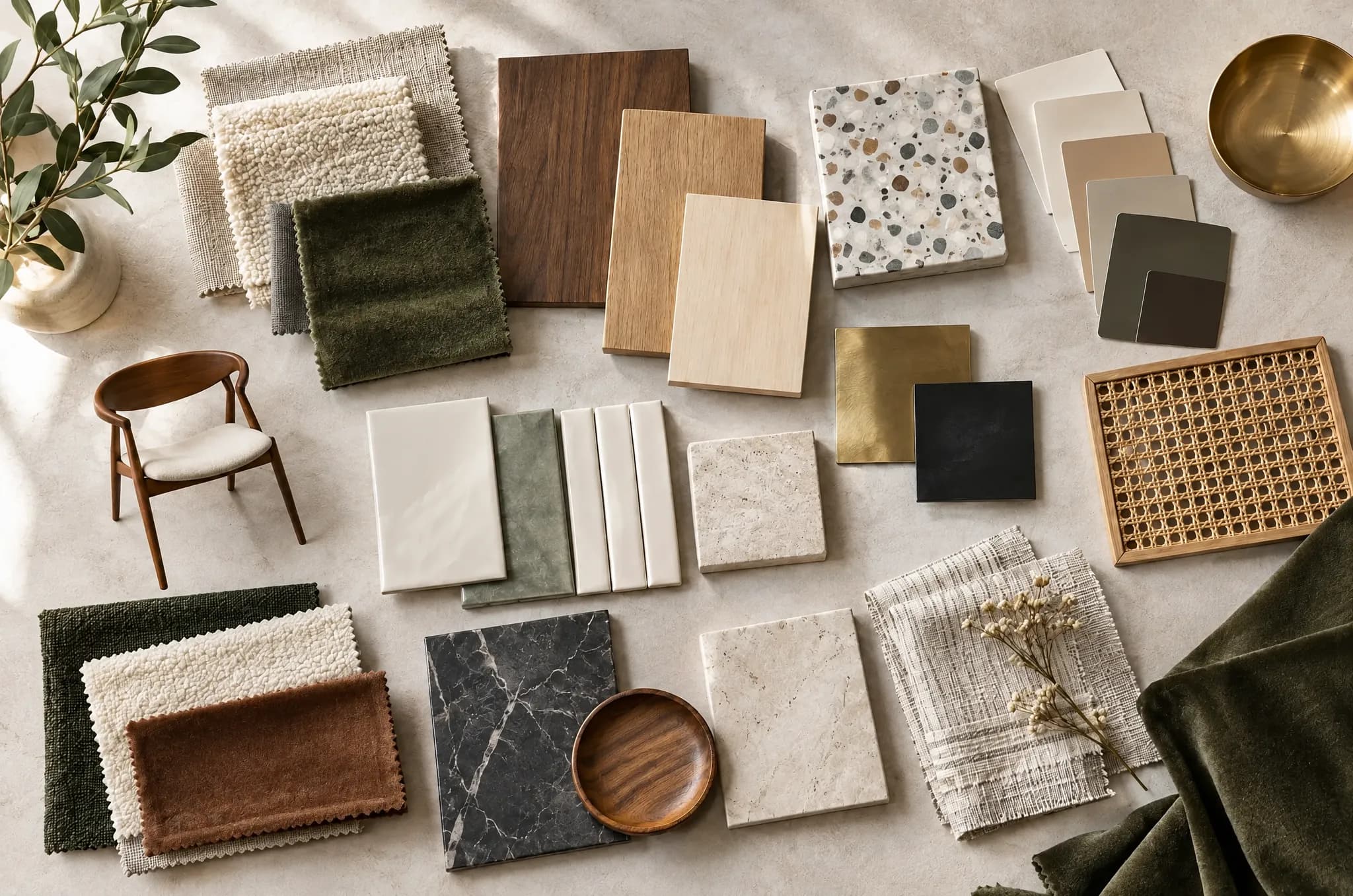
Because the palette is limited, the quality of materials matters more than usual. Choose a small set and repeat it.
- Wood — Light oak, ash or walnut with a matte, natural finish. Avoid heavy grain patterns and high-gloss lacquer.
- Stone and concrete — Honed stone, terrazzo or polished concrete for floors, worktops and side tables.
- Metal — Matte black, brushed steel or brushed brass in small quantities for lighting, legs and hardware.
- Glass — Clear or lightly tinted glass for shelving, partitions and tabletops keeps sightlines open.
- Textiles — Linen, cotton, wool and bouclé in solid colors. If you use pattern, keep it subtle, such as a fine stripe or a tone-on-tone weave.
What to Buy: A Minimalist Shopping List
You need less furniture than you think, but each piece does more work, so quality matters. In priority order:
- A well-proportioned sofa — Low back, slim arms and a solid base or thin legs. Choose a durable performance fabric in a mid-tone neutral so it hides daily wear.
- Good lighting — A dimmable ceiling or track system, one sculptural floor lamp and one table lamp per seating area. Lighting does more for atmosphere than any decorative object.
- A large rug — Big enough for the front legs of all seating to rest on it. Choose a flat weave in a tone close to the floor.
- One strong accent chair — A leather or bouclé lounge chair gives personality without clutter.
- Closed storage — A wall-hung cabinet, a low sideboard or built-in cupboards to hide everyday items.
- A coffee table with a clean profile — A stone slab, a slim wooden top or two nesting tables.
- Curtains or blinds that disappear — Sheer linen curtains or simple roller blinds in the wall color.
- One large artwork — Abstract, photographic or a simple line drawing.
Everything else, from cushions to candles, is optional. Buy accessories last and only when a space feels like it needs them.
Room-by-Room Guide
Living Room
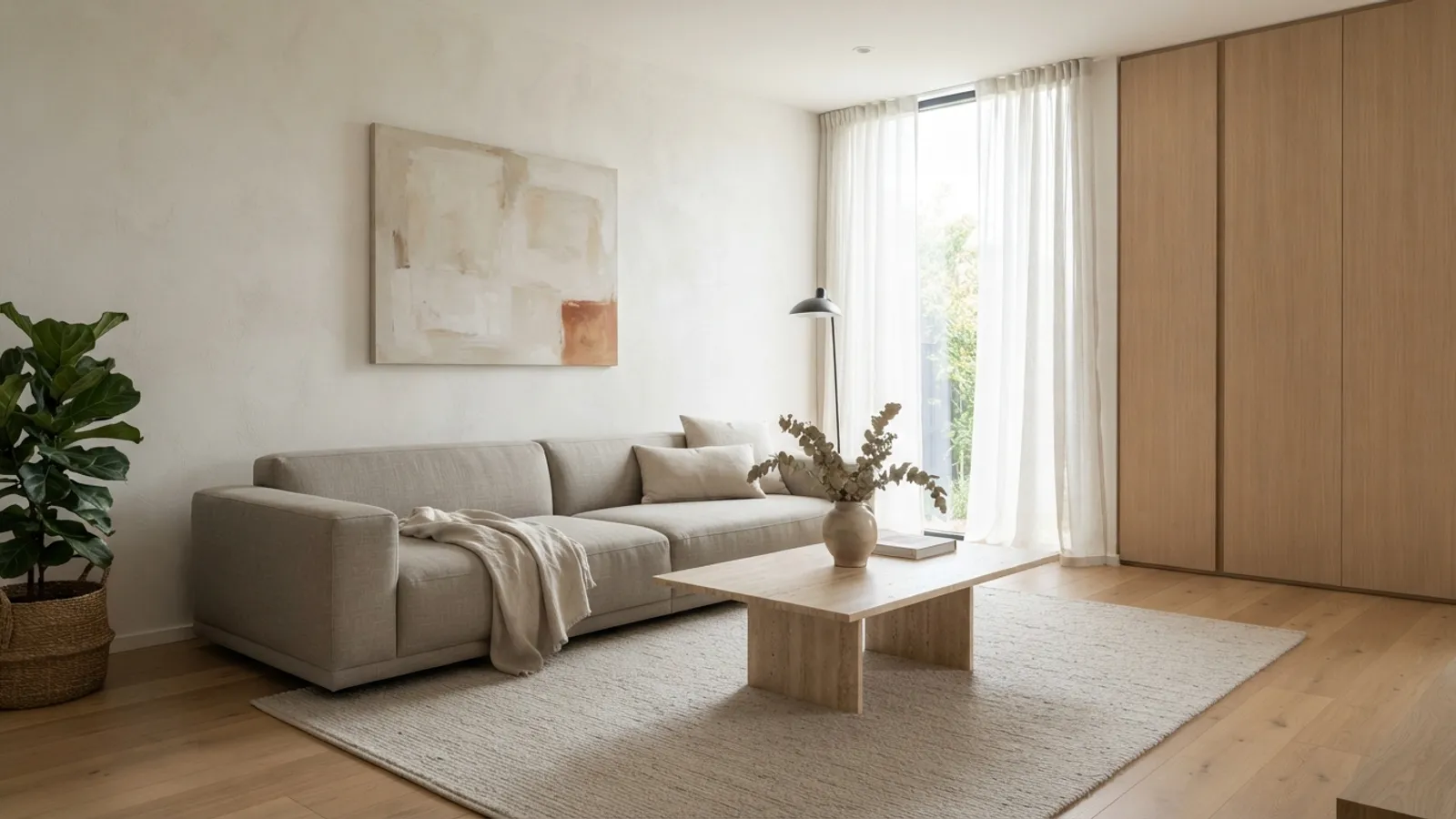
Choose a focal point, whether a view, a fireplace or a wall of art, and orient the seating toward it. Float the sofa on a large rug rather than pushing it against the wall, and keep the coffee table about 14 to 18 inches from the seat. Use a media unit with closed doors to hide cables and devices. For layouts and furniture suggestions, see our modern minimalist living room ideas.
Kitchen
Minimalist kitchens rely on continuity. Choose flat-panel, handleless cabinets in one color, a single worktop material and integrated appliances. Keep counters clear apart from one or two daily items. A wall of tall cabinets can hide a pantry, an oven and a refrigerator behind a uniform surface. Explore modern minimalist kitchen ideas for specific layouts and finishes.
Bathroom
Use large-format tile with thin grout lines on floors and walls, a wall-hung vanity with a single basin and a frameless glass screen. A recessed niche in the shower keeps bottles out of sight, and a large mirror with concealed lighting makes the room feel bigger. See modern minimalist bathroom ideas.
Home Office
A plain desk, a good chair and one task lamp are enough. Run cables through a tray or grommet and keep paper in a closed cabinet. Place the desk where daylight arrives from the side to reduce glare. Our modern minimalist home office ideas cover desk sizes and lighting.
Bedroom
Limit the room to a bed, two bedside tables and closed storage. Layer bedding in tonal linen and wool for warmth, and use wall-mounted lamps to keep surfaces clear. A single piece of art above the bed is plenty.
Lighting: The Quiet Hero
In a minimalist room there is little decoration to distract the eye, so the quality of light shapes everything. Plan three layers. Ambient light, usually recessed or track fittings on a dimmer, provides general illumination. Task light, such as a desk lamp or under-cabinet strip, supports specific jobs. Accent light, such as a wall washer or a lamp in a corner, adds depth in the evening.
Choose warm white bulbs of around 2700K to 3000K for living spaces and a slightly cooler 3500K to 4000K for kitchens and workspaces. Hide fittings where possible so that you see the light rather than the fixture.
Common Mistakes and How to Fix Them
- Confusing empty with minimal. A bare room is not automatically minimalist. Add one or two warm, tactile pieces, such as a wool throw or a ceramic bowl, so the space feels lived in.
- Painting everything the same flat white. Stark white walls, floors and furniture can look sterile. Use warm whites and vary the tones slightly between surfaces.
- Skipping storage planning. If belongings have nowhere to go, the room will not stay minimalist for a week. Plan storage first.
- Buying cheap basics. Plain furniture shows its quality very clearly. A well-made simple chair outlasts and outperforms a decorated cheap one.
- Ignoring comfort. If the sofa is hard or the chairs are cold, you will not use the room. Test seating in person.
- Forgetting acoustics. Hard surfaces and few soft furnishings make rooms echo. A rug, curtains and upholstered furniture solve this without visual clutter.
Budget Breakdown
These ranges are typical for a living room of around 200 square feet. Prices vary by region and by brand.
Refresh ($300 – $1,200)
Declutter, repaint in a warm neutral, replace bright bulbs with warm dimmable ones, add one large rug and a few quality textiles. This level changes the feel of a room more than most people expect.
Mid-Range ($3,000 – $8,000)
A new sofa, a coffee table, a media or storage unit, a rug, window treatments and a considered lighting plan. This is where the room starts to look intentionally designed.
Full Transformation ($12,000 – $30,000+)
New flooring, built-in storage, custom joinery, recessed lighting and designer seating. Large projects often benefit from a professional lighting plan and joinery design, which are difficult to correct once installed.
A good rule is to spend most on what you touch every day, such as the sofa, bed, lighting and flooring, and least on accessories.
Minimalism Compared With Similar Styles
Minimalism overlaps with several other calm, neutral styles, and choosing the right one depends on how much warmth and texture you want.
| Feature | Modern Minimalist | Scandinavian | Japandi |
|---|---|---|---|
| Palette | Cool or warm neutrals | Warm whites and pale wood | Earth tones and darker wood |
| Texture | Subtle | Rich and cozy | Handmade and organic |
| Decor | Minimal | Moderate | Curated and crafted |
| Mood | Calm, architectural | Bright, welcoming | Quiet, grounded |
If minimalism feels too austere, our guides to Scandinavian interior design and Japandi interior design show how to keep the calm while adding warmth.
Frequently Asked Questions
Is minimalist design cold?
It can be if it relies only on white surfaces and hard materials. Warm neutrals, natural wood, soft textiles and layered lighting give a minimalist room warmth without adding clutter.
Can a family live in a minimalist home?
Yes, with the right storage. Closed cabinets, durable fabrics and a place for toys and school items make a minimalist home easier to keep tidy, not harder. Perfect emptiness is not the goal.
How many objects should I display?
There is no fixed number, but a useful guide is to group items in threes or fewer and leave at least a third of each shelf or surface empty. Display things you love, and store the rest.
What is the difference between minimalist and modern?
"Modern" refers to a design movement of the early to mid twentieth century. "Minimalist" describes a reduction of objects and detail. A room can be modern without being minimalist, and vice versa, though the two often overlap.
How do I make a minimalist room feel personal?
Choose a few meaningful objects, such as a favorite book, a piece of pottery or a framed photograph, and give them space. Personal items stand out in a minimalist room precisely because there are few of them.
Try It on Your Own Room
The easiest way to see whether minimalism suits your home is to preview it. Upload a photo of your room to our AI interior design tool and see it restyled in seconds, free. You can compare it with other styles using the AI room design tool before buying anything.