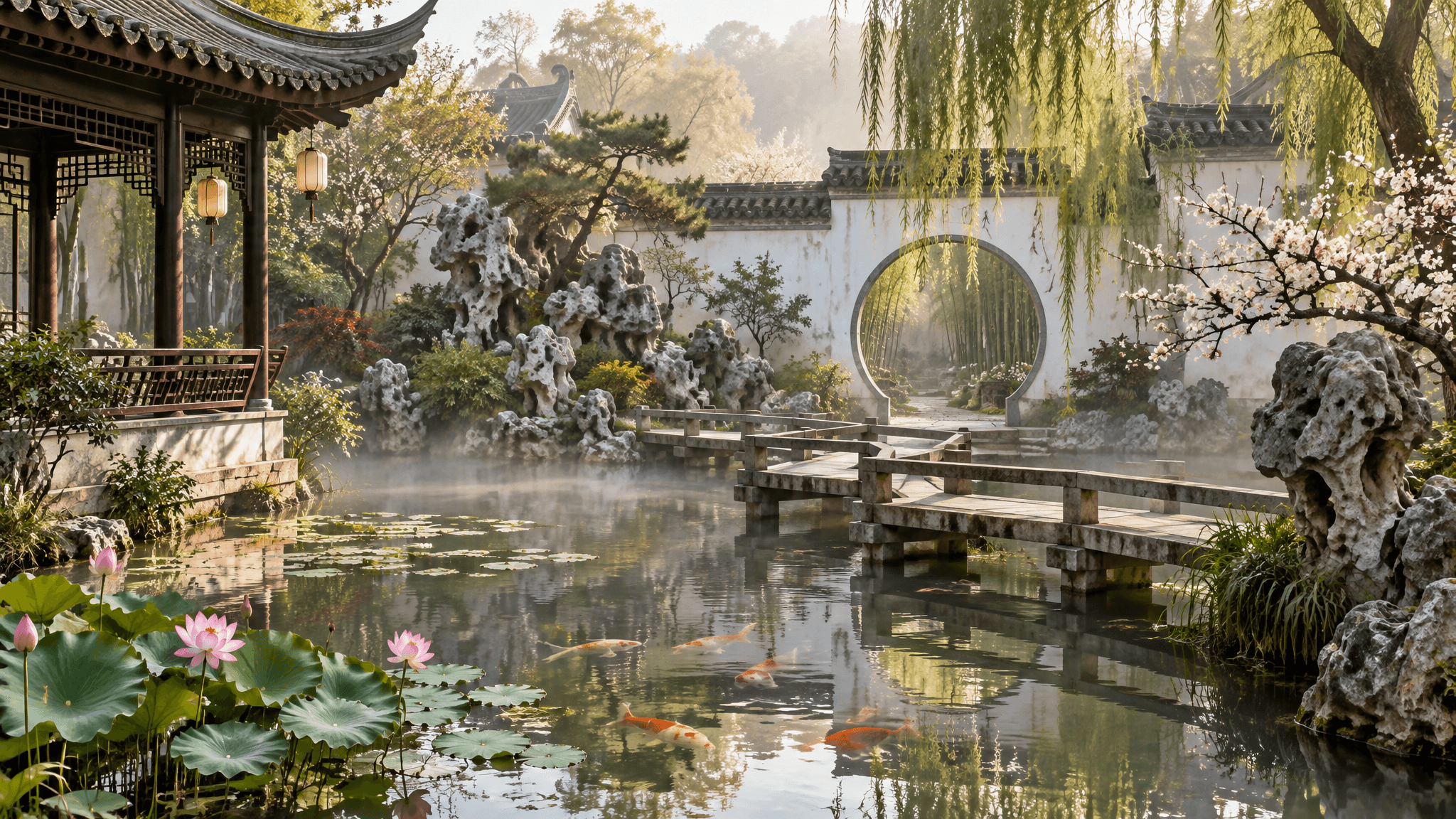
Jiangnan gardens are not gardens in the Western sense — they are three-dimensional landscape paintings you walk through. Born in the water towns south of the Yangtze River, these private scholar gardens reached their peak during the Ming and Qing dynasties (1368–1912) and left us nine UNESCO World Heritage sites in Suzhou alone. The design philosophy is deceptively simple: compress mountains and water into a courtyard, arrange architecture so every step reveals a new scene, and name each vignette after a line of classical poetry. The result is a space that feels vastly larger than its footprint and infinitely deeper than its walls.
What makes Chinese Jiangnan garden style relevant to modern homeowners is not its history — it is its spatial intelligence. Jiangnan designers solved the exact problem most suburban backyards face: how to make a small, enclosed space feel expansive, layered, and emotionally resonant. Their toolkit of borrowed views, framed scenes, winding paths, and hidden courtyards translates directly to a 2,000-square-foot backyard. You do not need a Suzhou mansion. You need a wall, a pond, a rock, and a plan.
The Six Design Principles of Jiangnan Gardens
Understanding these principles is more important than copying specific elements. They are the operating system; the rocks and moon gates are just the interface.
1. Borrowed Scenery (借景 Jie Jing)
The most powerful technique in the Jiangnan toolbox. Borrowed scenery means deliberately incorporating views from outside the garden — distant mountains, a neighbor's tall tree, a passing cloud framed by a window — into the garden experience. Ji Cheng, the Ming-dynasty garden master who wrote Yuan Ye (The Craft of Gardens, 1631), considered this the highest skill: making the garden appear to contain what it does not own.
In practice, this means designing walls, windows, and gates to frame specific external views rather than simply enclosing the property. A circular moon gate at the end of a path that captures a slice of sky and a neighbor's magnolia tree extends your garden's perceived boundary far beyond the fence.
2. Framed Scenery (框景 Kuang Jing)
Where borrowed scenery looks outward, framed scenery looks inward. Moon gates, lattice windows (漏窗), doorways, and gaps between buildings turn the garden into a series of carefully composed pictures. You do not see the entire garden at once — you see one scene at a time, each framed like a painting on a wall.
This serial reveal is what makes a 500-square-foot courtyard feel like a journey. Stand at the entrance and you see a rockery blocking your view. Pass through a moon gate and a pond appears. Cross a bridge and a pavilion reveals itself behind bamboo. Each frame is complete in itself, and each transition creates anticipation for the next.
3. Winding Paths and Changing Scenes (曲径通幽)
Straight lines are almost absent in Jiangnan gardens. Paths curve, bridges zigzag, corridors bend. The purpose is not decorative — it is perceptual. A winding path makes a short distance feel long. A zigzag bridge forces you to pause and look sideways at each turn, tripling the number of views you experience. The classical phrase is "一步一景" (one step, one scene): every pace should offer something new.
4. Contrast of Void and Solid (虚实相生)
Jiangnan gardens constantly alternate between enclosure and openness, density and emptiness, solid walls and transparent lattice. A tight corridor suddenly opens onto a broad pond. A dense rockery gives way to flat water reflecting nothing but sky. This rhythm of compression and release is what creates the emotional depth — the feeling that the garden breathes.
5. Mountains and Water as Structure (山水为骨)
Every Jiangnan garden is built on the ancient Chinese concept of shan shui — mountains and water. Rockery represents mountains; ponds and streams represent water. Together they form the structural skeleton of the garden. All other elements — architecture, planting, paths — are arranged around this mountain-water framework. A garden without rock and water is like a poem without a subject.
6. Poetry and Naming (诗意命名)
In classical Jiangnan gardens, every pavilion, hall, and scenic vignette has a literary name drawn from poetry, philosophy, or nature. The Humble Administrator's Garden in Suzhou takes its name from a Jin-dynasty essay; its "Listening to Rain" pavilion is placed where rain on banana leaves creates a meditative sound. This naming tradition is not mere decoration — it tells visitors what to see, hear, and feel in each spot.
For a modern backyard, this principle translates to intentional storytelling: give each area a purpose and a mood rather than treating the yard as undifferentiated space.
Essential Elements for Your Jiangnan Garden
Rockery (假山)
Taihu limestone is the signature material — porous, irregular, full of holes and peaks that suggest mountain landscapes in miniature. Classical aesthetics prize four qualities in garden rocks: thinness (瘦), wrinkling (皱), permeability (漏), and transparency (透). A good Taihu stone looks like it was carved by centuries of water erosion — which it was.
Modern application: Source limestone, sandstone, or volcanic rock with similar textural qualities. A single upright feature stone at a path junction or beside a pond creates the mountain element. Three to five stones grouped asymmetrically suggest a mountain range. Avoid perfectly round boulders — Jiangnan aesthetics demand angular, vertical, complex forms.
Budget tip: A striking feature stone costs $200–$800 depending on size and region. Limestone and sandstone with natural weathering are more affordable than imported Taihu stone. Place the tallest stone off-center and the smallest at the edges to create natural depth.
Water (水景)
Water is the soul of a Jiangnan garden — a still pond reflecting sky and architecture, a narrow stream connecting different zones, or even a small basin holding a single lotus. The water surface should be raised close to the surrounding ground level so you can almost touch it from the path, creating an intimate relationship between land and water.
Modern application: A lined pond of 80–200 square feet is sufficient for a residential Jiangnan garden. Keep it simple — still water with a few koi and lotus pads, bordered by natural stone rather than concrete coping. A recirculating pump hidden in the rockery can create a gentle stream feeding the pond. For very small spaces, a glazed ceramic water bowl (缸) with a miniature lotus achieves the same philosophical effect.
Moon Gate (月洞门)
The circular doorway is the most recognizable element of Chinese garden architecture. Symbolizing the full moon, reunion, and welcome, a moon gate frames a scene and creates a threshold between garden zones. Traditional moon gates are built from brick or stone; modern versions use corten steel, powder-coated aluminum, or even trained wisteria on a circular frame.
Sizing: 4–5 feet (1.2–1.5m) in diameter for a residential garden. Place it at the end of a path so it frames one specific composition — a rock, a pond, a specimen tree. Never let it frame a fence or a shed.
Lattice Windows (漏窗)
Garden walls in Jiangnan are not barriers — they are canvases pierced by decorative windows that filter views between spaces. Traditional patterns include ice-crack, interlocking coins, and hexagonal lattice. These windows create visual connection between garden zones without removing the sense of enclosure.
Modern application: A whitewashed or rendered garden wall with one to three cutout openings — circular, hexagonal, or custom geometric — achieves the effect. Back-lit lattice screens in timber or metal are a contemporary alternative that works on patios and along fences.
Zigzag Bridge (曲桥)
A zigzag or arched bridge over water is both functional and philosophical. The zigzag form forces you to pause at each turn and changes your viewing angle repeatedly, multiplying the scenes you experience during a single crossing. In Chinese folklore, evil spirits can only travel in straight lines — a zigzag bridge keeps them at bay.
Modern application: Even a 6-foot timber bridge with one 90-degree turn over a narrow stream section creates the full perceptual effect. Paint or stain it dark gray or natural timber — avoid the bright red of temple bridges unless you want a purely decorative statement.
Pavilion (亭)
An open-sided pavilion positioned beside or over water is the garden's resting point and viewing platform. It provides shade, frames views in four directions, and serves as a social gathering spot. Traditional pavilions have upturned eaves and elaborate joinery, but a modern interpretation can be as simple as a timber pergola with a bench overlooking the pond.
Plant Selection for a Jiangnan Garden
Jiangnan planting is deeply symbolic. Each plant carries literary and philosophical associations that have been codified for centuries. You are not choosing plants for color — you are casting characters in a story.
The Four Gentlemen (四君子)
| Plant | Season | Symbolism | Role in Garden |
|---|---|---|---|
| Plum blossom (Prunus mume) | Winter/early spring | Resilience, purity | Specimen near entrance or beside rock |
| Orchid (Cymbidium spp.) | Spring | Elegance, refinement | Understory in shaded corners |
| Bamboo (Phyllostachys spp.) | Year-round | Integrity, flexibility | Screening, backdrop, grove |
| Chrysanthemum (Chrysanthemum spp.) | Autumn | Endurance, reclusion | Mass planting in beds |
Water and Pondside Plants
- Lotus (Nelumbo nucifera) — The essential Jiangnan water plant. Emerges from mud to bloom in purity. Plant in pond baskets with heavy clay soil at 12–18 inches depth. Hardy in USDA zones 4–10.
- Water lily (Nymphaea spp.) — Floating leaves and blooms for smaller ponds where lotus would overwhelm the scale.
- Sweet flag (Acorus calamus) — Grasslike foliage along pond edges. Traditionally one of the "five auspicious plants" for the Dragon Boat Festival.
- Weeping willow (Salix babylonica) — Arching branches that trail over water, creating the classic Jiangnan waterside silhouette. Needs space — use only if your pond area exceeds 300 square feet.
Structural and Screening Plants
- Bamboo (Phyllostachys aurea or Fargesia spp.) — Use clumping varieties (Fargesia) for controlled screening, or running types (Phyllostachys) with root barriers for the authentic dense grove effect. Bamboo rustling in wind (竹声) is considered a soundscape element.
- Pine (Pinus thunbergii or P. parviflora) — Gnarled, cloud-pruned pines are living sculptures in Jiangnan gardens. Position one as a specimen beside the rockery.
- Banana (Musa basjoo) — Large tropical leaves provide dramatic texture, and rain hitting banana leaves is a celebrated garden sound ("听蕉" — listening to banana rain). Hardy to USDA zone 5 with mulching.
- Osmanthus (Osmanthus fragrans) — Tiny flowers release an extraordinary fragrance in autumn. Place near a seating area or window for what the Chinese call "桂花飘香" (osmanthus fragrance floating in the air).
Groundcover and Accent
- Moss — Encouraged on rocks and stone paths in shaded areas. Creates the appearance of age and permanence.
- Nandina (Nandina domestica) — Red berries in winter, fine-textured foliage year-round. Traditional "lucky" plant placed near entrances.
- Chinese wisteria (Wisteria sinensis) — Train over a pergola, moon gate frame, or courtyard wall for cascading spring blooms.
Materials and Surfaces
Walls
Whitewashed walls (粉墙) with gray tile capping are the canvas of a Jiangnan garden. They serve three purposes: enclosure, backdrop for shadows and plantings (bamboo shadows on white walls is a celebrated aesthetic), and support for lattice windows and moon gates. Use smooth render or lime plaster in off-white, topped with dark gray coping tiles or sheet metal flashing.
Paving
Traditional Jiangnan gardens use pebble mosaic paths (花街铺地) — small stones arranged in patterns depicting flowers, animals, cranes, or geometric designs. Simpler options include:
- Irregular stone slabs set in gravel — naturalistic and low-cost
- Granite pavers in a running bond — clean and durable
- Stepping stones across gravel or moss — for secondary paths through planted areas
Timber
Dark-stained or naturally weathered timber for bridges, pavilion frames, and railings. Traditional Jiangnan woodwork is unpainted, relying on the warmth of aged timber against white walls and green foliage. Cedar, teak, or pressure-treated pine all work for modern construction.
Layout Strategy: Designing Your Jiangnan Backyard
Start With the Wall
Unlike Western gardens that begin with lawn and add features, a Jiangnan garden begins with enclosure. Build or designate walls that define the garden boundary and create the canvas for your composition. Even a single L-shaped wall creates an enclosed corner that can function as a complete garden-within-a-garden.
Place Water and Rock
Position your pond (or water feature) and primary rockery as the first two decisions after walls. These form the shan-shui skeleton. The pond should be visible from the main viewing point — typically from the house or a key seating area. The rockery creates visual weight and vertical drama on one side of the water.
Add Architecture
A moon gate, lattice window, or pavilion creates the framing devices that turn the composition into a sequence of scenes. Even one moon gate and one lattice window transform a flat backyard into a multi-room experience. Use our AI landscape design tool to visualize different placements before committing to construction.
Layer the Planting
Plant the structural backbone first — bamboo screening, specimen pine or plum, pondside lotus. Then add seasonal layers: osmanthus for autumn fragrance, banana for summer drama, chrysanthemum for fall color. Finally, add groundcover: moss on rocks, nandina at the base of walls, and wisteria climbing a gate frame.
Connect With Paths
Link the zones with curving paths that reveal each scene sequentially. No straight sightlines. Every path should have at least one bend that creates anticipation, and at least one point where a framed view (through a window, gate, or gap in planting) rewards the walker's attention.
Budget Guide
Jiangnan garden design rewards patience and restraint. A single well-placed rock, one small pond, and a bamboo screen can carry more beauty than $50,000 of unfocused landscaping.
| Level | What You Get | Estimated Cost (USD) |
|---|---|---|
| DIY Starter | Feature stone + small lined pond + bamboo screen + pebble paths + 5–8 plants | $2,500 – $6,000 |
| Mid-Range | Rendered wall with moon gate + koi pond + rockery + timber bridge + full planting + lighting | $10,000 – $25,000 |
| Premium | Professional masonry walls + multiple garden rooms + pavilion + stream system + mature specimens + custom lattice | $30,000 – $70,000 |
Cost-saving strategies: Source local stone with interesting weathering rather than imported Taihu limestone. Use corten steel for a moon gate frame instead of masonry (saves $1,000+). Plant bamboo from 1-gallon containers — it reaches screening height in 2–3 seasons. Build the garden in phases: walls and water first, architecture and planting second, refinement over years.
Maintenance Guide
Medium — A Jiangnan garden requires more attention than a minimalist gravel yard but less than a formal English garden. The key tasks are water quality management and bamboo control.
Regular Tasks
- Pond: Monitor water clarity weekly; beneficial bacteria and a basic filter keep koi ponds healthy. Remove dead lotus leaves in autumn. Run a small pump year-round in freezing climates to prevent ice damage.
- Bamboo: Running bamboo needs annual rhizome pruning or a permanent root barrier (60cm deep HDPE). Clumping types need no barrier but benefit from division every 3–4 years.
- Walls: Whitewashed surfaces may need touch-up every 2–3 years depending on climate. Moss growth on walls is often desirable — remove only if structural.
- Rockery: No maintenance. Encourage moss and lichen growth for a mature appearance.
- Pruning: Cloud-prune pines annually in late spring. Trim wisteria after blooming and again in late winter. Let plum blossom develop naturally — minimal pruning preserves the gnarled character.
Jiangnan Garden vs. Japanese Zen Garden
Both draw from shared Asian philosophical roots, but the experience is fundamentally different:
- Jiangnan is lush, layered, and literary — it invites you to wander through a landscape poem with multiple scenes, sounds, and seasons. Water is alive with lotus and koi. Architecture is prominent.
- Japanese Zen is sparse, meditative, and contemplative — it invites you to sit still and see everything from one position. Water may be represented by raked gravel. Architecture recedes.
If you want a garden you walk through and discover, Jiangnan is your style. If you want a garden you sit beside and contemplate, explore Japanese Zen. Many homeowners blend elements from both — a Zen-style rock garden in one corner, a Jiangnan-style pond and pavilion in another.
Visualize Your Jiangnan Garden
Not sure how this ancient style would look on your modern property? Upload a photo of your yard to our AI landscape design tool and see it transformed into a Jiangnan garden in seconds — whitewashed walls, rockery, koi pond, moon gate, and all. Compare it instantly with related styles: the Japanese Zen approach for a more minimal interpretation, or the Classical European garden for a Western take on formal garden design.
Explore more landscape design inspiration in our backyard ideas gallery, or browse all available design styles to find the perfect match for your space.