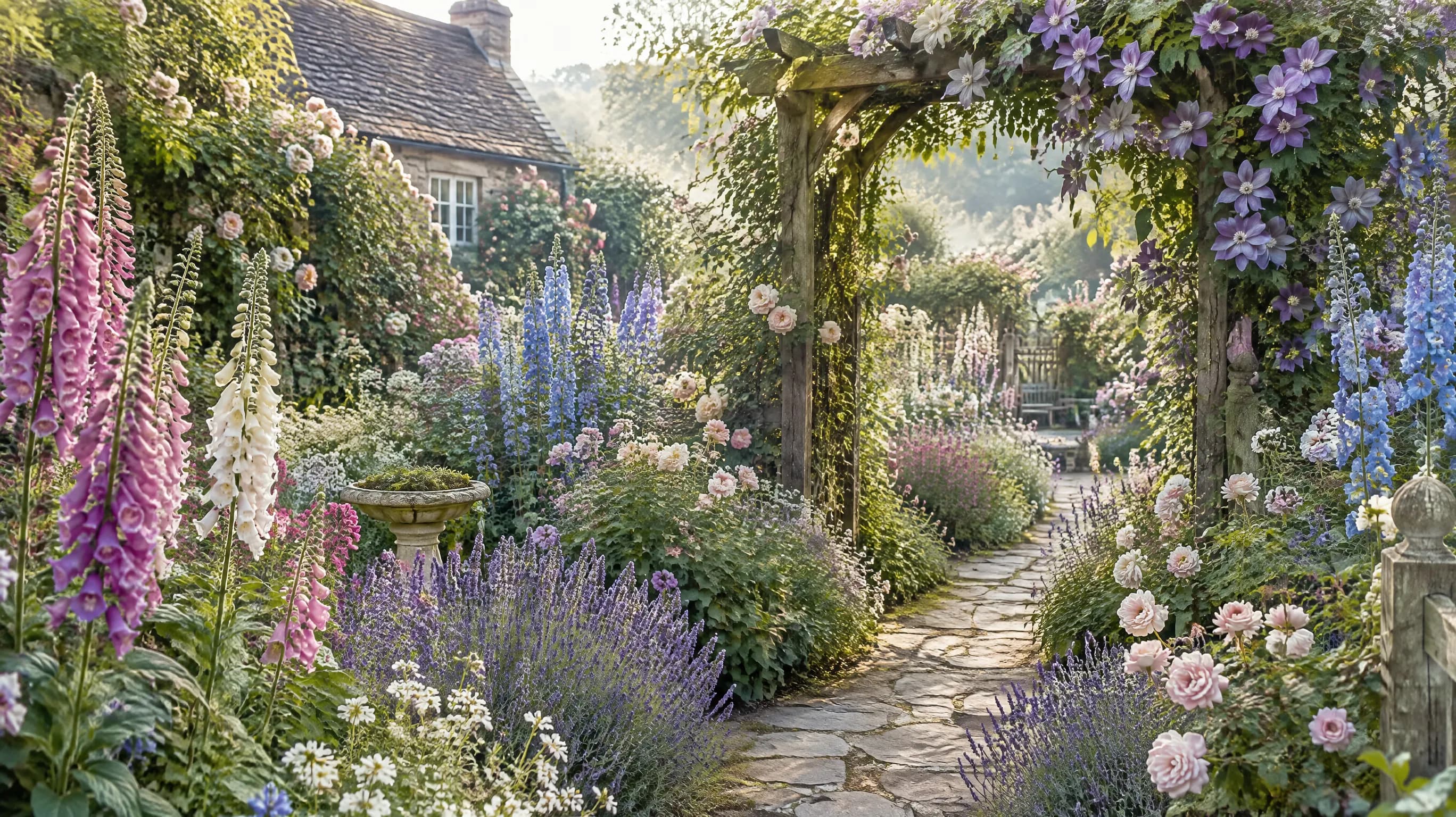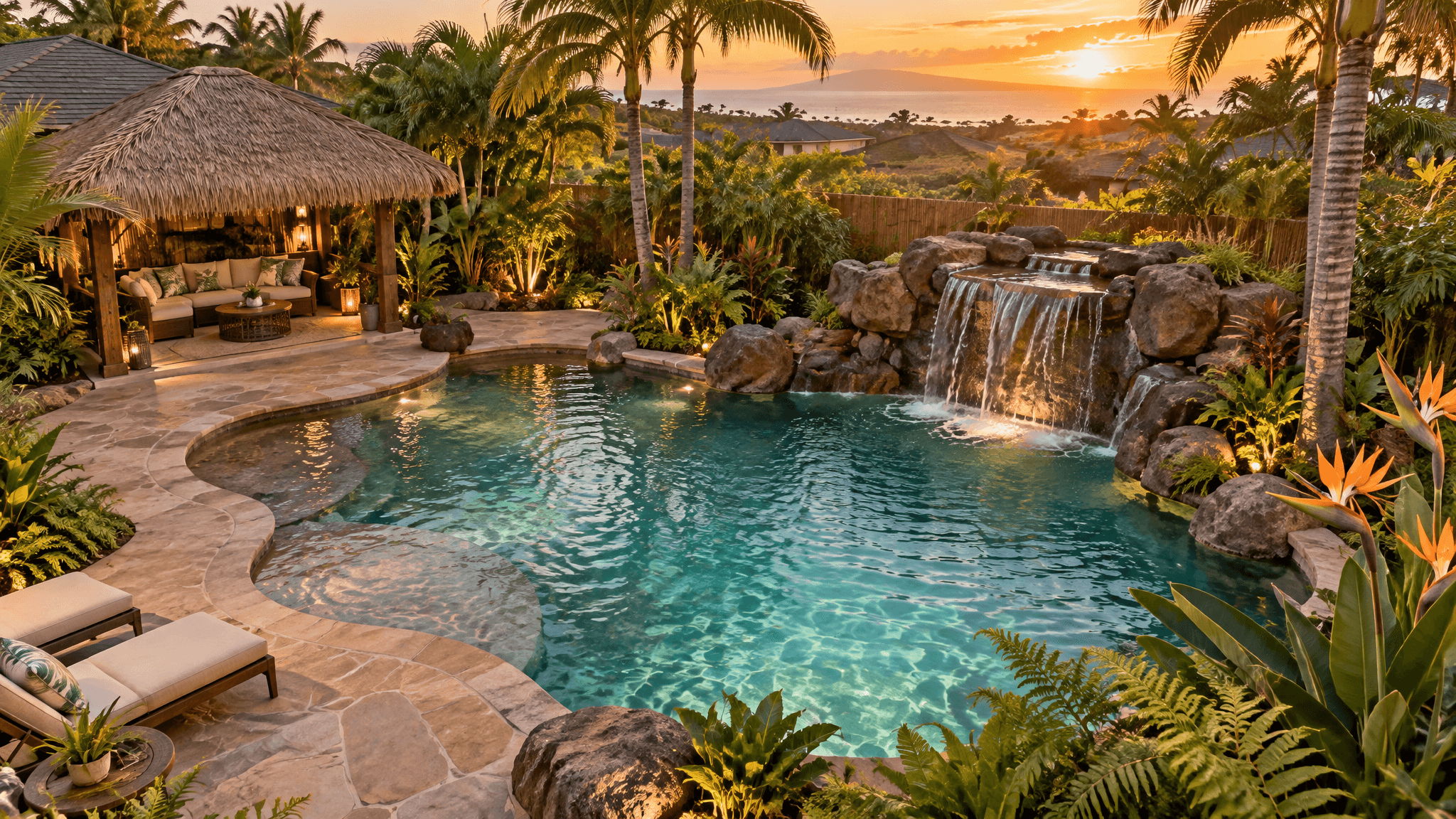
You have seen the photos — a freeform lagoon pool framed by towering palms, bird of paradise flaming against a bamboo fence, a thatched cabana with a cold drink waiting on the counter. Then you look at your own backyard and wonder whether "resort at home" is a fantasy reserved for Hawaiian hotels and Balinese villas. It is not. A tropical resort-style backyard is not about climate — it is about layering, bold foliage, and designing outdoor rooms that make you forget the property line exists.
In 2026, the tropical backyard trend has moved beyond the Sun Belt. Homeowners in Portland, Charlotte, and even Chicago are building convincing tropical spaces by combining cold-hardy substitutes with the spatial principles that make a resort feel immersive. This guide walks you through every step — from the five design zones that structure a tropical yard to plant palettes for warm and cool climates, hardscape materials, and honest budget numbers.
Why Tropical Resort Design Works in Residential Backyards
The tropical resort aesthetic translates to home gardens because it shares three principles with good residential design: layered screening for privacy, distinct outdoor rooms for different activities, and lush planting that reduces the visual presence of fences and buildings. A resort pool area feels expansive not because it is large, but because the planting wraps around you and hides the boundaries.
That same trick works in a 30-by-50-foot suburban backyard. Plant tall palms and clumping bamboo along the fence line, drop the mid-story planting density so you see through it to the pool, and suddenly the yard feels twice its actual size. Add a thatched shade structure and warm 2700K lighting, and the transformation is complete — even in a development with cookie-cutter lots on every side.
The Five Design Zones
Professional tropical landscape designers think in five vertical and functional layers. Understanding these zones is the single most important step, because every plant and material decision flows from them.
Zone 1: Canopy Layer (15–30 ft)
The overhead plane. Tall palms, shade trees, and large tropical specimens create the vertical drama that says "resort" before anything else registers. In warm climates (USDA zones 9–11), use royal palms, queen palms, or coconut palms. In cooler zones, windmill palm (Trachycarpus fortunei, hardy to zone 7a) or cold-hardy banana (Musa basjoo, root-hardy to zone 5) provide the silhouette without the winter risk.
The canopy layer is not meant to be dense. Two to four well-placed tall specimens create more impact than a wall of trees. Position them to frame views — one pair flanking the pool, another near the entry path — rather than lining the perimeter in a row.
Zone 2: Mid-Story (3–15 ft)
The visual depth layer. Bird of paradise (Strelitzia reginae), giant philodendron, croton, and plumeria fill the space between the canopy and the ground, creating the lush density that separates a tropical garden from a yard with a couple of palms stuck in it.
This layer does the heaviest lifting for the "immersive" feeling. Plant in overlapping clusters — three bird of paradise behind a group of crotons behind a mass of bromeliads — so the eye travels through multiple textures before reaching the fence.
Zone 3: Ground Cover (0–3 ft)
The floor. Bromeliads, caladium, liriope, and ferns carpet the soil between larger specimens. In a resort, you never see bare mulch — the ground plane is always covered with low planting that adds texture and color at ankle height.
Use contrast deliberately: fine-textured ferns against broad-leafed caladium, silver-green liriope against deep-red bromeliads. The contrast between leaf sizes is what keeps the layered composition from reading as an undifferentiated wall of green.
Zone 4: Seating and Hardscape
The human layer. Teak furniture, natural stone or flagstone patios, a thatched cabana or palapa, and a pool area that functions as an outdoor living room. Hardscape materials should be natural, textured, and warm — never smooth poured concrete, which reads suburban rather than tropical.
The seating zone is where the resort fantasy becomes practical. A shaded dining area for eight, a lounging platform near the pool, and a bar counter (swim-up or deck-side) give the yard distinct destinations that pull you outside every evening.
Zone 5: Perimeter Screening (6–20 ft)
The enclosure layer. Clumping bamboo (Bambusa multiplex — always clumping, never running), areca palms, and dense tropical hedging along the property boundary serve a double purpose: privacy from neighbors and the visual illusion that there is no boundary at all.
Screen planting should be thick enough to hide the fence completely within two to three growing seasons. Plant on 3-to-4-foot centers for bamboo and 4-to-6-foot centers for areca palm, and maintain a consistent height across the entire perimeter.
Choosing Your Plant Palette
Warm Climate Palette (Zones 9–11)
These are the plants that grow in actual tropical resorts — no substitutes needed.
Canopy and Mid-Story
| Plant | Height | Character |
|---|---|---|
| Royal Palm (Roystonea regia) | 40–60 ft | The iconic smooth-trunked resort palm |
| Coconut Palm (Cocos nucifera) | 30–50 ft | Arching fronds, unmistakably tropical |
| Bird of Paradise (Strelitzia reginae) | 4–6 ft | Orange and blue flowers, bold paddle leaves |
| Plumeria (Plumeria rubra) | 15–25 ft | Intensely fragrant tropical flowers |
| Traveler's Tree (Ravenala madagascariensis) | 20–30 ft | Dramatic fan-shaped leaf arrangement |
Ground Cover and Accent
| Plant | Height | Character |
|---|---|---|
| Bromeliads (Neoregelia, Aechmea) | 1–2 ft | Bold rosettes in red, pink, and green |
| Caladium (Caladium bicolor) | 1–2 ft | Heart-shaped leaves in pink, white, and green |
| Giant Elephant Ear (Alocasia macrorrhizos) | 4–8 ft | Massive upright leaves, architectural drama |
| Croton (Codiaeum variegatum) | 3–6 ft | Multicolored foliage — red, orange, yellow, green |
| Cast Iron Plant (Aspidistra elatior) | 2 ft | Bulletproof shade groundcover |
Cool Climate Palette (Zones 5–8)
The secret to a tropical-looking garden in a cold climate is texture mimicry. You cannot grow a coconut palm in Connecticut, but you can create the same visual impression with cold-hardy substitutes.
Canopy and Mid-Story
| Plant | Height | Minimum Zone | Mimics |
|---|---|---|---|
| Windmill Palm (Trachycarpus fortunei) | 15–25 ft | 7a | Fan palms |
| Hardy Banana (Musa basjoo) | 10–15 ft | 5a (mulched) | True banana — dies back, regrows annually |
| Needle Palm (Rhapidophyllum hystrix) | 6–8 ft | 6b | Shrub-sized palm accent |
| Canna Lily (Canna indica) | 4–6 ft | 7a (dig and store below) | Tropical paddle foliage + bright flowers |
| Hardy Hibiscus (Hibiscus moscheutos) | 4–6 ft | 5a | Dinner-plate-sized tropical blooms |
Ground Cover and Accent
| Plant | Height | Minimum Zone | Mimics |
|---|---|---|---|
| Elephant Ear (Colocasia esculenta) | 3–5 ft | 8a in ground; dig below | Bold tropical foliage |
| Japanese Fiber Banana (Musa basjoo) | 6–10 ft | 5a (roots) | Banana grove effect |
| Adam's Needle (Yucca filamentosa) | 3–5 ft | 4a | Evergreen spiky tropical accent |
| Ostrich Fern (Matteuccia struthiopteris) | 3–5 ft | 3a | Tropical fern understory |
| Persian Shield (Strobilanthes dyerianus) | 2–3 ft | Annual above zone 9 | Iridescent purple foliage |
The layering trick for cold climates: Plant evergreen structural species (windmill palm, yucca, needle palm) for year-round tropical bones. Fill around them with die-back-and-return plants (hardy banana, canna, elephant ear) that explode into lush growth every summer. By July, the combination is visually indistinguishable from a zone 10 garden.
Hardscape Materials That Sell the Resort Feel
Material choice is where most DIY tropical yards fall short. Smooth concrete, plastic edging, and pressure-treated lumber scream "suburban patio" regardless of how many palms you plant around them.
Paving
- Natural flagstone (bluestone, sandstone) — Irregular shapes, warm tones, natural texture. The top choice for pool decks and pathways.
- Travertine pavers — Cool underfoot in summer, resort-grade appearance. Common in high-end tropical pool surrounds.
- Decomposed granite — Warm buff color, compacts well for pathways between planting beds. Budget-friendly and authentic.
Fencing and Screening
- Bamboo fencing — Real bamboo panels tied with natural cord. Replace every 3–5 years outdoors, or use bamboo-look composite for permanence.
- Natural stone walls — Stacked or dry-laid fieldstone retaining walls for grade changes and raised planting beds.
- Lava rock borders — Dark volcanic rock in garden beds adds texture contrast against green foliage.
Shade Structures
- Thatched palapa or tiki hut — The definitive tropical shade structure. Authentic Polynesian thatching lasts 5–7 years; synthetic thatch lasts 15+ years.
- Balinese-style cabana — Timber posts with canvas or fabric drapes. More refined than a tiki hut, equally tropical.
- Pergola with vine canopy — Train passionflower, bougainvillea, or trumpet vine for living shade that is both functional and spectacular.
Furniture
Teak, rattan, or woven synthetic wicker in natural tones. Avoid powder-coated metal or painted finishes — they belong in contemporary designs, not tropical ones.
Water Features: The Resort Differentiator
A pool is the centerpiece of most tropical resort backyards, but even without a pool, moving water transforms the space.
With a Pool
The tropical pool is freeform — organic curves, no sharp right angles. Key features that separate a resort pool from a standard rectangle:
- Beach entry (zero-depth edge) — A gradual slope into the water, mimicking a natural shoreline. Costs $5,000–$12,000 added to the pool build.
- Natural rock waterfall — Boulders stacked to create a cascade into the pool. Budget $12,000–$28,000 for authentic rockwork.
- Dark pebble interior — A dark-blue or charcoal pebble finish makes the water look deep and tropical, reflecting the surrounding greenery.
- Spa/hot tub spillover — An elevated spa that overflows into the main pool creates the sound of falling water constantly.
Without a Pool
- Pondless waterfall — A recirculating waterfall that disappears into a gravel basin. Low maintenance, safe for children, and provides the sound of moving water. $3,000–$8,000 installed.
- Tropical pond — A small naturalistic pond with aquatic plants and a single bubbling rock. Creates a habitat for frogs and dragonflies that add to the tropical atmosphere. $1,500–$5,000.
- Rain curtain — A sheet of water falling from a horizontal pipe mounted on a pergola. Contemporary, dramatic, and surprisingly affordable ($800–$2,000 for a DIY kit).
Lighting That Extends the Illusion
Tropical backyards come alive after dark when the right lighting is in place. The guiding principle: warm color temperature (2700K), concealed fixtures, and dramatic up-lighting.
Essential Lighting Zones
- Palm uplights — One in-ground LED uplight at the base of each major palm tree. The fronds glow from below, creating the signature resort silhouette against the night sky.
- Pathway lights — Low-voltage bollards or step lights along stone paths. Place every 6–8 feet, staggered side to side.
- Water feature lights — Submersible LED strips behind waterfalls and inside the pool. Warm white, not color-changing.
- Shade structure lighting — String lights (café-style, warm-white LEDs) draped under the palapa or pergola. Simple, effective, and universally flattering.
- Fire features — A gas fire pit or fire bowls flanking the pool add warmth, light, and a focal point for evening gatherings. Budget $2,000–$8,000 for a built-in gas fire pit.
Budget Guide: What This Actually Costs
Tropical resort backyards span a wide budget range depending on whether you include a pool and how much custom construction is involved.
Landscape-Only (No Pool)
| Level | What You Get | Estimated Cost (USD) |
|---|---|---|
| DIY Starter | Bamboo fence section, 3–5 palms, tropical planting beds, gravel path, string lights | $3,000 – $7,000 |
| Mid-Range | Flagstone patio, layered tropical planting, pondless waterfall, tiki shade structure (delivered), landscape lighting | $12,000 – $30,000 |
| Premium | Professional design, mature palm specimens, custom cabana, fire pit, full landscape lighting, irrigation | $35,000 – $75,000 |
Full Resort (With Pool)
| Level | What You Get | Estimated Cost (USD) |
|---|---|---|
| Base Package | Freeform gunite pool, basic rock waterfall, tropical planting around pool, pool lighting | $90,000 – $150,000 |
| Mid-Range Resort | Pool + spa spillover + beach entry, tiki bar, mature tropical planting, full landscape lighting | $150,000 – $250,000 |
| Ultimate Resort | Pool + grotto + slide, outdoor kitchen, swim-up bar, cabana, fire features, theatrical lighting | $250,000 – $450,000+ |
Where the money goes: The pool shell and custom rockwork account for 50–60% of the total in a full resort build. Planting typically runs 8–12% — which means skimping on plants is the worst mistake you can make, since it is the greenery that sells the entire illusion.
Step-by-Step Build Sequence
Whether you hire a contractor or tackle this as a multi-year DIY project, follow this order:
Phase 1: Hardscape and Infrastructure (Weeks 1–6)
- Clear the site and set final grades
- Install pool shell (if applicable) and plumbing
- Build patios, pathways, and retaining walls
- Install electrical for lighting, pumps, and outlets
- Run irrigation mainline and drip zones
Phase 2: Structures (Weeks 5–8)
- Build or install the shade structure (palapa, cabana, pergola)
- Install fencing and screening framework
- Build the outdoor bar or kitchen counter
- Install fire pit or fire bowls
Phase 3: Planting (Weeks 7–10)
- Amend soil in all planting beds (2–3 inches of compost worked in)
- Plant canopy trees and palms first — they define the spatial structure
- Install mid-story planting in overlapping clusters
- Fill ground plane with groundcover and accent plants
- Mulch all beds with 3 inches of shredded hardwood or lava rock
Phase 4: Finishing (Weeks 9–12)
- Install landscape lighting and test all zones
- Hang string lights under shade structures
- Place furniture, containers, and decorative pots
- Final irrigation adjustment and system testing
- Plant container specimens (orchids, bromeliads) on tables and bar surfaces
Maintenance Calendar
Tropical gardens demand more upkeep than xeriscape or minimalist designs, but the work is straightforward.
Spring: Fertilize palms and tropical plants with slow-release fertilizer. Prune dead palm fronds. Start drip irrigation schedule. Plant annuals and tender tropicals after last frost (cold-climate gardens).
Summer: Water deeply 2–3 times per week during heat. Monitor for palm-scale insects. Trim back fast-growing groundcovers. Clean pool filters and check water chemistry weekly.
Fall: Reduce watering frequency. In cold climates, dig and store cannas, elephant ears, and other tender bulbs before first frost. Wrap windmill palms with burlap in borderline zones. Cut back spent perennials.
Winter: In warm climates, this is the easy season — minimal watering, occasional pruning. In cold climates, protect palm trunks with insulation, mulch hardy banana stumps heavily (12+ inches of leaves or straw), and enjoy the structural bones of the garden.
Common Mistakes to Avoid
Scattering plants randomly. A single palm here, one bird of paradise there, and a random clump of ferns somewhere else looks like a plant collection, not a resort. Group in clusters of 3–5 and layer by height. Density is the difference between "tropical" and "a few tropical plants."
Choosing smooth concrete for everything. The pool deck, the pathway, the patio — all poured concrete in matching gray. Natural stone, textured pavers, and decomposed granite create the organic character that concrete cannot. If budget forces concrete, at least use a stamped or exposed-aggregate finish.
Ignoring the sound layer. A resort feels tropical partly because of what you hear: water flowing, wind in palm fronds, birds. If you skip the water feature, the yard looks tropical but does not feel it. Even a small recirculating fountain makes a meaningful difference.
Planting for summer only. In zones 7–8, an all-deciduous tropical garden disappears completely by November. Include evergreen structure (windmill palm, yucca, cast iron plant, needle palm) so the yard has bones year-round.
Underestimating irrigation. Tropical plants drink. A drip irrigation system with smart controller is not optional — it is the infrastructure that keeps the illusion alive. Hand-watering a tropical garden is a full-time job by midsummer.
Start With a Visualization
Not ready to commit to a full build? Upload a photo of your backyard to our AI landscape design tool and see it transformed into a Tropical Resort in seconds. You can compare it against other warm-climate styles like Mediterranean Garden or Contemporary Coastal to find the vibe that fits your lifestyle.
The AI preserves your existing structures — the fence, the garage, the old concrete pad — and reimagines the landscape around them. It takes 30 seconds and costs nothing.