Scandinavian garden design does not try to impress. It invites you to sit, breathe, and stay — through every season. Where other styles chase color or spectacle, the Nordic approach trusts that honest materials, hardy plants, and a fire pit on a cool evening will do what no amount of bedding plants can: make you actually use your garden. The Scandinavian landscape style borrows from the Nordic concepts of friluftsliv (open-air living), hygge (coziness), and lagom (just the right amount) to build outdoor spaces that work as hard in November as they do in June.
In 2026, this approach is gaining serious traction outside Scandinavia. Warmer summers, rising water costs, and a cultural shift toward low-maintenance outdoor living have made the Nordic garden a practical choice for homeowners everywhere — not just in Stockholm or Copenhagen. This guide covers the philosophy, the real plants that define the look, the materials that ground it, and the layout strategies that turn an ordinary backyard into a calm, year-round retreat.
What Makes a Scandinavian Garden
A Scandinavian garden is not a minimalist garden that happens to contain birch trees. It is a design philosophy built on five interconnected principles:
1. Year-Round Usability — Friluftsliv
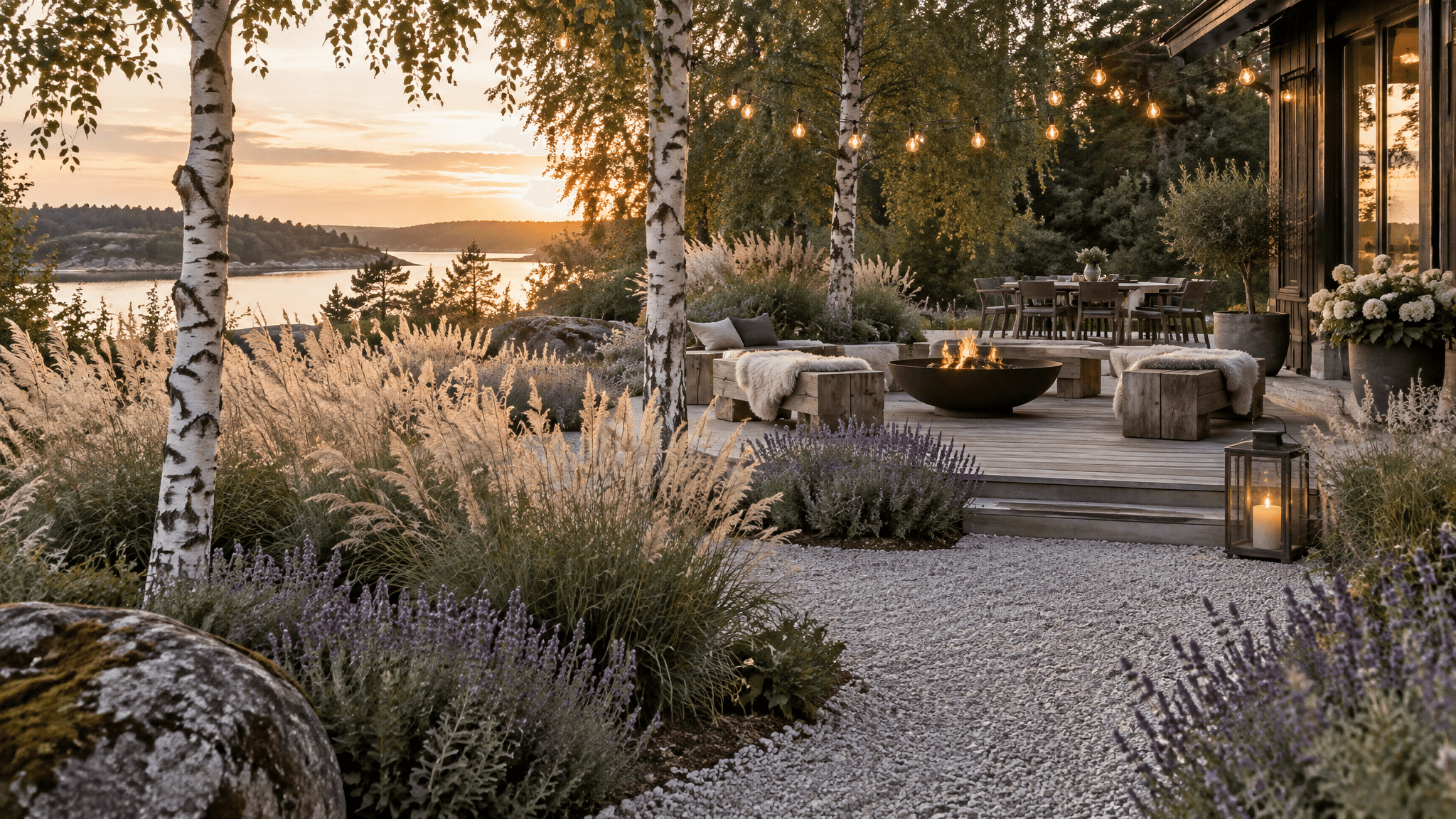
In Nordic culture, there is no bad weather — only bad clothing. The garden is designed for daily use across all four seasons, not just summer entertaining. This means sheltered seating out of the prevailing wind, a fire pit or chiminea that extends evenings into autumn and winter, and surfaces that stay safe underfoot when wet or frosty. Textured natural stone and timber decking with non-slip profiles replace polished paving that becomes treacherous in rain.
2. Material Honesty
Every material is left to express its true nature. Timber is untreated or lightly oiled, allowed to weather to the characteristic silver-gray that Scandinavians consider beautiful rather than neglected. Stone is rough-hewn, not polished. Gravel is natural aggregate, not dyed. Metal is galvanized steel or corten, developing patina over time rather than being painted. Nothing pretends to be something it is not.
3. Restrained Plant Palette
A Scandinavian garden uses fewer species than an English cottage border, but uses each one with conviction. Instead of one of everything, you plant drifts of five or seven — a sweep of ornamental grass, a mass of lavender, a grove of three birch trees. The repetition creates visual calm rather than the visual noise of a crowded mixed border.
4. Light as a Design Material
Nordic light is low, golden, and directional for much of the year. Scandinavian garden designers treat this as an asset, not a limitation. Grasses are positioned where backlight catches their seed heads. Birch bark glows against gray winter skies. Warm-toned outdoor lighting — string lights, lanterns, uplights at 2700K — extends the garden's usable hours and creates the hygge atmosphere after dark.
5. Functional Beauty — Lagom
Every element earns its place through both function and aesthetics. A bench is not decorative furniture — it is a weatherproof seat where you drink morning coffee. A raised bed is not an ornament — it grows herbs you cook with. A fire bowl is not a showpiece — it warms your hands in October. The result is a garden where nothing feels superfluous or contrived.
Essential Plants for a Scandinavian Garden
The plant palette is deliberately limited. Choose from these categories and your garden will look authentically Nordic while demanding minimal maintenance.
Specimen Trees
| Tree | Character | USDA Zones | Notes |
|---|---|---|---|
| Silver birch (Betula pendula) | White bark, dappled shade | 2–7 | The signature Scandinavian tree; luminous in winter, golden autumn foliage |
| Amelanchier (Amelanchier lamarckii) | Four-season interest | 4–8 | White spring flowers, summer berries, brilliant autumn color, elegant winter silhouette |
| Swedish whitebeam (Sorbus intermedia) | Dense canopy, white spring flowers | 4–7 | Native Scandinavian tree with excellent year-round structure |
| Mountain ash (Sorbus aucuparia) | Pinnate leaves, orange-red berries | 3–7 | Attracts birds; berries glow against gray autumn skies |
Ornamental Grasses
Grasses are the backbone of Scandinavian planting. They bring movement, catch light, and hold their structure through winter frost.
- Feather reed grass (Calamagrostis × acutiflora 'Karl Foerster') — Bolt-upright stems that stand through winter. Plant in drifts of 5–7 along paths or deck edges.
- Tufted hair grass (Deschampsia cespitosa) — Fine-textured mounds with airy flower heads that shimmer in morning backlight.
- Purple moor grass (Molinia caerulea 'Transparent') — Graceful, transparent flower stems that sway in the lightest breeze.
- Blue fescue (Festuca glauca) — Low, steely-blue mounds for edging paths and gravel terraces.
Perennials and Ground Cover
- English lavender (Lavandula angustifolia) — Fragrant, silver-leaved, and polled by bees. Mass-plant at path edges.
- Yarrow (Achillea millefolium) — Flat flower heads in white or soft pink. Drought-tolerant and wild-looking.
- Sedum (Sedum spp.) — Low-water succulents for green roof sections, wall tops, and gravel pockets.
- Hardy geraniums (Geranium spp.) — Reliable groundcover with long bloom period and neat foliage.
- Hostas (Hosta spp.) — Bold-leaved shade plants for the understory beneath birch canopy.
- Ferns — Dryopteris and Polystichum varieties for woodland-floor texture in shaded areas.
Berry Bushes and Edibles
Foraging is central to friluftsliv. Include at least one edible layer:
- Lingonberry (Vaccinium vitis-idaea) — Low evergreen groundcover with tart red berries.
- Blueberry (Vaccinium angustifolium) — Autumn leaf color and summer fruit.
- Wild strawberry (Fragaria vesca) — Groundcover that produces tiny, intensely flavored fruit.
- Rhubarb (Rheum rhabarbarum) — Bold structural accent that doubles as a culinary ingredient.
Materials and Hardscape
In a Scandinavian garden, materials matter more than plants. They set the mood, define the spaces, and weather gracefully over decades.
Timber
Untreated larch or Douglas fir is the default decking material. It weathers naturally to silver-gray — fighting this process with stain or sealant is considered counter to the aesthetic. Build a generous deck as the main gathering area: wide enough for a dining table, a lounge corner, and circulation between them. For outbuildings or fences, consider black-stained timber (the traditional Nordic "Falu red" or carbon black) as a backdrop that makes pale planting pop.
Gravel and Stone
Gravel replaces lawn in many Nordic gardens. Choose pale gray, warm sand, or natural aggregate in muted tones. The crunch underfoot is part of the sensory experience. For paths and stepping routes, use granite setts or limestone pavers with slightly uneven surfaces that stay safe when wet.
Metalwork
Galvanized steel planters, corten steel fire bowls, and simple steel edging provide clean lines without ornament. The metal develops patina naturally, reinforcing the weathered material theme.
Textiles and Warmth
Sheepskin throws over benches, wool blankets in baskets beside seating, and outdoor cushions in natural cream and gray tones are not accessories — they are infrastructure. They make the garden usable in temperatures that would send most people indoors.
Layout Strategy: Designing Your Scandinavian Garden
Zone Your Space
Divide the garden into three functional zones connected by gravel or timber paths:
-
Gathering Zone — Adjacent to the house. A timber deck or gravel terrace with a dining table, fire pit, and sheltered seating. This is where 80% of outdoor time happens. Position it out of the prevailing wind and consider a simple timber pergola or sail shade for rain protection.
-
Planting Zone — Surrounding the gathering area. Grasses in sweeping drifts, birch specimens underplanted with ferns and hostas, and lavender masses along path edges. Use gravel or bark chip as mulch rather than exposed soil.
-
Productive Zone — Raised timber beds for herbs and berries, positioned where they get the best light. Keep them within easy reach of the kitchen for daily harvesting.
Design Principles
- Frame views with vertical elements — A trio of birch trunks, a timber pergola post, or tall grasses create depth and draw the eye through the space.
- Keep the palette tight — Limit hardscape to two materials (e.g., timber + gravel) and plants to six to eight species. Repetition is strength.
- Layer lighting in warm tones — String lights overhead at 2700K, lanterns on tables, uplights on birch trunks, and path lights at ground level. Never use a single floodlight.
- Leave space for fire — A fire pit or fire bowl with generous seating radius (at least 6 feet) is essential, not optional. Design ideas for fire pit areas can inspire your layout.
- Face seating toward the best view — Usually back toward the house or toward a birch grove or open sky.
Small Garden Adaptation
Even a 150-square-foot courtyard can feel Scandinavian. Use a single galvanized planter with a dwarf birch, a gravel floor, two or three grasses in pots, and a small fire bowl. Add a simple timber bench with a sheepskin and string lights overhead. The small garden ideas page has more compact layout inspiration.
Budget Guide
Scandinavian gardens are inherently cost-effective because the core materials — untreated timber, gravel, and hardy perennials — are among the most affordable options in landscape design.
| Level | What You Get | Estimated Cost (USD) |
|---|---|---|
| DIY Starter | Gravel terrace + fire bowl + birch specimen + lavender mass + simple timber bench + string lights | $2,000 – $5,000 |
| Mid-Range | Professional gravel and timber deck + steel planters + irrigation + landscape lighting + fire pit | $8,000 – $18,000 |
| Premium | Designer outdoor room with custom timber structures, built-in seating, premium stone, mature birch specimens, and full lighting design | $20,000 – $45,000 |
Money-saving tips: Buy ornamental grasses as small plugs and plant in autumn — they fill out within two seasons. Source untreated larch from local timber yards rather than landscape suppliers. Use self-sourced gravel from aggregate quarries for significant savings over bagged product. Phase the project: start with the gathering zone and fire pit, then add planting zones over the following seasons.
Maintenance Calendar
This is where the Scandinavian approach truly excels. Ongoing effort is minimal and predictable:
- Spring: Cut back ornamental grasses to 4 inches before new growth starts. Rake and refresh gravel surfaces. Divide perennials every 3–4 years.
- Summer: Deadhead lavender after the first bloom flush. Water newly planted specimens weekly until established. Established plants need almost no irrigation.
- Fall: Clear fallen birch leaves from gravel and deck surfaces. Enjoy the golden autumn color. Leave grass seed heads standing for winter interest.
- Winter: Enjoy the structural beauty of frosted grasses, birch bark against gray skies, and fire pit evenings. No maintenance required.
Common Mistakes to Avoid
Overcomplicating the palette. If you have more than eight plant species and three hardscape materials, you have lost the Scandinavian simplicity. Edit ruthlessly.
Treating timber. The silver-gray weathering of untreated larch and pine is part of the aesthetic. Staining or sealing it dark brown creates a completely different mood and adds annual maintenance.
Skipping the fire element. A fire pit or fire bowl is not a luxury add-on — it is the single element that extends your garden's usable season by three to four months. Budget for it first, not last.
Installing bright white lighting. Cool-white LEDs at 5000K destroy the hygge atmosphere. Use 2700K warm white exclusively. String lights and lanterns are more effective than spotlights.
Ignoring winter appearance. A Scandinavian garden must look intentional from November through March. Choose plants with strong winter silhouettes — grasses with persistent seed heads, birch with white bark, evergreen dwarf conifers. If your garden looks abandoned in January, it is not Scandinavian.
Scandinavian vs. Japandi: What Is the Difference?
The related Japandi style merges Scandinavian minimalism with Japanese wabi-sabi aesthetics. Both share a love of natural materials and restrained palettes. The key differences:
- Japandi adds asymmetric stone arrangements, raked gravel, and moss — drawing from Zen garden principles.
- Scandinavian emphasizes warmth and gathering — fire pits, textiles, and edible planting — drawing from the social tradition of friluftsliv.
- Japandi tends toward contemplation; Scandinavian tends toward habitation.
Both are excellent low-maintenance styles. If you lean toward quiet meditation, explore Japandi. If you lean toward cooking outside with friends on a cool evening, Scandinavian is your match.
Visualize Before You Build
Not sure whether Scandinavian is the right style for your space? Upload a photo of your yard to our AI landscape design tool and see it transformed into a calm Nordic garden in seconds. You can also compare it with related styles like Japanese Zen for a more contemplative approach, or Modern Minimalist for crisper architectural lines.
The AI preserves your existing structures and reimagines the landscape around them — no commitment required, no sign-up needed.