
Design Philosophy
Southwest courtyard design is rooted in a building tradition that has thrived in the American desert for over four hundred years. When Spanish colonists arrived in New Mexico and Arizona in the 1600s, they merged their Mediterranean courtyard architecture with the adobe construction already practiced by Pueblo peoples for centuries before that. The result was a landscape form perfectly adapted to extreme heat, scarce water, and brilliant desert light — an enclosed outdoor room that creates shade, traps cool evening air, and frames the sky as a living ceiling.
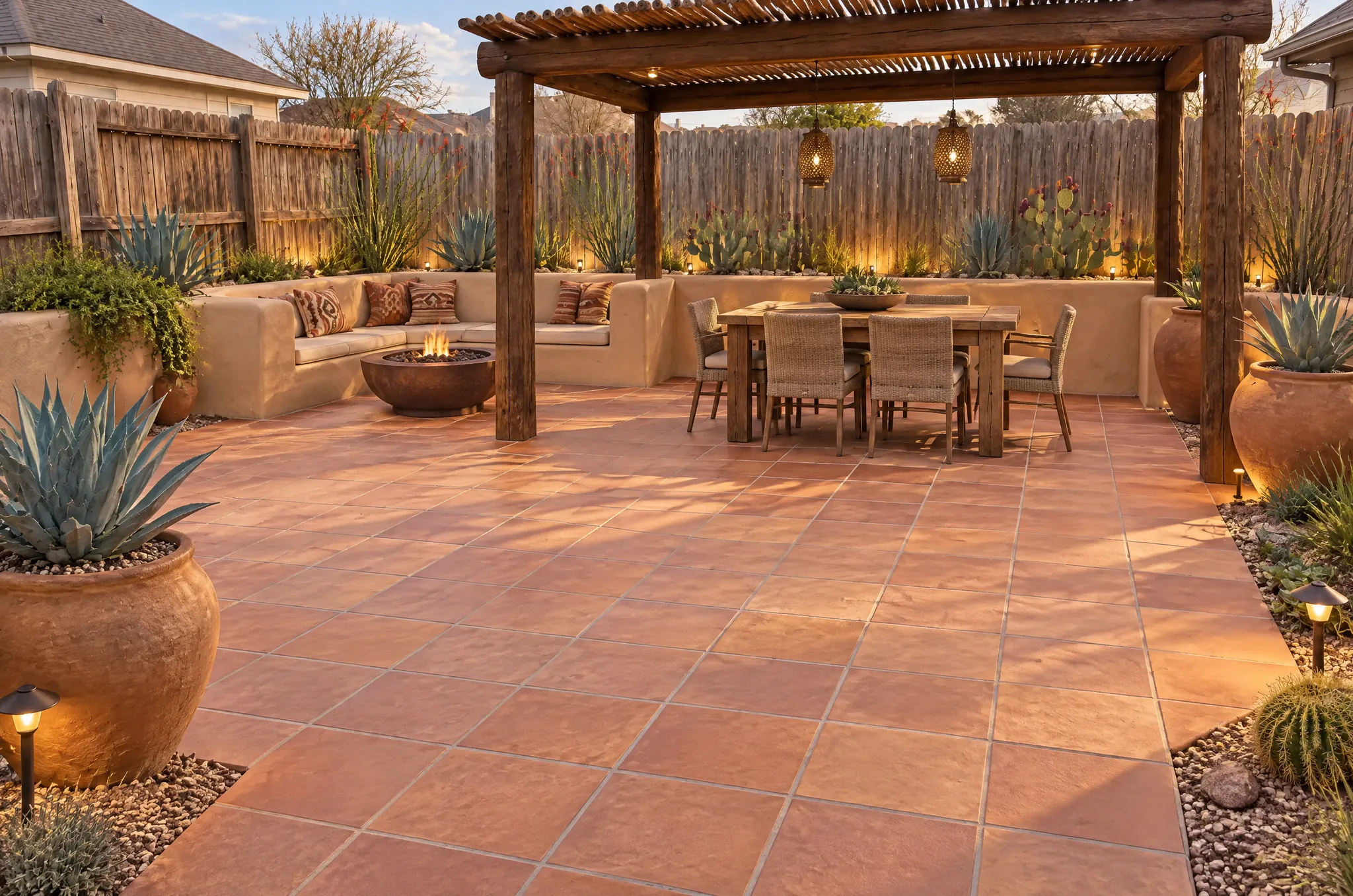
The philosophy is radical subtraction. Where English gardens add layer upon layer of planting, and Mediterranean landscapes build lushness through irrigation, the Southwest courtyard strips the landscape down to essentials: earth-toned walls, a permeable gravel floor, a few sculptural plants placed with the precision of furniture, and one water feature — a simple recirculating fountain or a hand-glazed olla — that cools the air and provides the only sound besides wind. Every element earns its place through function first, beauty second.
This restraint creates something paradoxical: a space that feels more alive than a heavily planted garden. When the ground plane is quiet — warm decomposed granite, hand-laid flagstone, a few terracotta pots — the plants that do appear command absolute attention. A single blue agave against an adobe wall becomes a sculpture. A palo verde tree casting lacework shadow on buff stucco becomes the entire composition. The desert teaches a lesson that residential design everywhere could use: less planting, better planting, and more trust in the architecture of the space itself.
In 2026, Southwest courtyard design is finding a national audience. As water restrictions tighten across the western United States and homeowners everywhere search for landscapes that thrive with minimal irrigation, this centuries-old desert approach offers a proven template — beautiful, resilient, and requiring almost nothing from the municipal water supply once established. For a related arid-climate approach, see our Desert Xeriscape style guide.
Key Design Elements
- Enclosed Courtyard Walls — Adobe, stucco, dry-stacked stone, or plastered concrete block walls (4–6 feet) create a sheltered microclimate, block wind, trap evening cool air, and provide a warm-toned backdrop for shadow play.
- Decomposed Granite Ground Plane — Warm-toned DG in desert gold, terracotta, or sandy buff as the primary permeable surface, raked or stabilized for a clean, functional floor that absorbs no water and reflects minimal glare.
- Sculptural Plant Placement — Individual specimen plants (agave, yucca, prickly pear) positioned as focal points against walls or at corners rather than massed in borders — each plant is a deliberate design choice.
- Shade Structures — Ramadas (open-sided post-and-beam shelters), pergolas with latilla or peeled-log roofing, or shade sails oriented to block western and southern afternoon sun while allowing winter light.
- Water Feature — A small recirculating fountain, wall-mounted spout, or hand-glazed olla (clay pot) that provides the cooling sound of water without significant water consumption (5–10 gallons/month recirculating).
- Terracotta and Talavera Accents — Hand-painted Mexican Talavera tiles on risers, fountain basins, or wall niches; terracotta pots in varying sizes for container plantings; warm clay tones that echo the earth.
- Wrought Iron and Rustic Wood — Hand-forged iron gates, candle lanterns, wall sconces, and furniture paired with weathered mesquite or reclaimed timber benches and tables.
- Dry Creek Bed or Arroyo — A naturalistic channel of river rock and boulders that manages monsoon stormwater runoff while creating a beautiful dry-season landscape feature.
Recommended Plants & Materials
Plants
- Architectural Specimens: Blue agave (Agave americana) — dramatic blue-gray rosette, the defining Southwest plant; Spanish dagger (Yucca gloriosa) — sword-like leaves with white bell flowers; Prickly pear (Opuntia engelmannii) — sculptural pads with spring blooms in yellow, orange, or magenta
- Shade Trees: Palo verde (Parkinsonia spp.) — green-barked desert tree with yellow spring flowers, dappled shade; Desert willow (Chilopsis linearis) — orchid-like blooms in pink, burgundy, or white; Mesquite (Prosopis velutina) — spreading canopy, deep-rooted, virtually indestructible
- Flowering Accents: Desert marigold (Baileya multiradiata) — bright yellow blooms nearly year-round; Red penstemon (Penstemon eatonii) — scarlet tubular flowers that draw hummingbirds; Autumn sage (Salvia greggii) — red, pink, or coral blooms from spring through fall
- Ornamental Grasses: Deer grass (Muhlenbergia rigens) — graceful native bunchgrass with airy seed plumes; Blue grama (Bouteloua gracilis) — delicate eyelash-shaped seed heads; Mexican feather grass (Nassella tenuissima) — fine-textured and flowing in the slightest breeze
- Container Plants: Trailing rosemary — cascading over pot edges, fragrant, edible; Aloe vera — medicinal and sculptural in terracotta pots; Globe mallow (Sphaeralcea ambigua) — apricot-orange flowers, native, self-seeding
- Groundcovers: Desert zinnia (Zinnia acerosa) — white daisy-like flowers on silver mounds; Trailing lantana (Lantana montevidensis) — purple or white flower clusters, fast-spreading; Blackfoot daisy (Melampodium leucanthum) — cheerful white blooms, limestone lover
Materials & Colors
- Walls: Adobe or rammed earth (authentic but expensive: $15–$30/sq ft), stuccoed concrete block (practical and widely available: $8–$15/sq ft), dry-stacked sandstone or limestone
- Ground Surfaces: Decomposed granite in desert gold or terracotta tones ($3–$6/sq ft installed), hand-cut flagstone in warm sandstone or Arizona buff ($12–$25/sq ft), saltillo terracotta tile for covered areas ($8–$15/sq ft)
- Accent Materials: Talavera hand-painted tiles (blue, yellow, terracotta patterns), Corten steel planters and edging (weathered rust finish), cobblestone or river rock for dry creek beds
- Color Palette: Adobe tan, terracotta, warm sand, clay red, turquoise blue (accent only), sage green, rust orange — the palette of the Sonoran Desert at golden hour
Best For
Southwest courtyard design is ideal for homeowners who want an enclosed, intimate outdoor living space that thrives in heat and drought with minimal maintenance:
- Desert Southwest homeowners — Arizona, New Mexico, West Texas, and Southern Nevada, where the style is native and the climate demands it (USDA zones 7b–10b)
- Water-conscious homeowners in any arid region — the enclosed courtyard uses 80–90% less water than a traditional lawn-based landscape, making it relevant from Southern California to the Texas Hill Country
- Small-lot and urban properties — courtyard design excels on compact lots where walls create privacy and enclosure that fencing alone cannot provide; a 400-square-foot courtyard feels like a complete outdoor room
- Homeowners seeking privacy — the walled courtyard is the most private outdoor space in residential design, blocking street noise, neighbor sightlines, and wind simultaneously
- Adobe, Pueblo Revival, and Territorial-style homes — architecturally, the Southwest courtyard is the natural landscape companion to these building styles; it feels historically correct and visually cohesive
- Entertainers who prefer intimate gatherings — the courtyard scale (typically 200–600 sq ft) is perfect for dinner parties of 4–8 rather than large backyard events
Budget Guide
| Level | Scope | Estimated Cost (USD) |
|---|---|---|
| DIY Starter | Stuccoed block walls (one or two sides, 30 linear ft) + decomposed granite + 5–8 container plants + simple fountain | $3,000 – $8,000 |
| Mid-Range | Full courtyard enclosure + DG and flagstone paving + shade ramada + drip irrigation + specimen agave and tree + Talavera accents | $12,000 – $30,000 |
| Premium | Adobe or rammed-earth walls + custom saltillo tile + hand-forged iron gate + mature specimen trees + landscape lighting + built-in seating + recirculating wall fountain | $35,000 – $75,000 |
Installed costs typically range from $15 to $40 per square foot for a complete courtyard buildout, depending heavily on wall construction (stuccoed block vs. authentic adobe), paving material, and plant maturity. The enclosed nature of the courtyard means the total area is usually modest (200–600 sq ft), which keeps absolute project costs lower than open-yard landscapes of comparable quality.
Maintenance Level
Low — The Southwest courtyard is one of the lowest-maintenance landscape styles in residential design. Once specimen plants are established (6–12 months with supplemental drip irrigation during the first growing season), most require no supplemental water beyond monsoon rainfall in the desert Southwest, and only occasional deep watering in the hottest weeks (June, July) for shade trees.
Seasonal maintenance is straightforward: spring inspection of drip emitters and replacement of clogged or sun-damaged tubing, light raking of decomposed granite to maintain even coverage, removal of spent flower stalks on agaves and yuccas, pruning of palo verde and mesquite to maintain canopy clearance (once annually in late winter), and cleaning of the fountain pump filter (monthly during use). Fertilization is unnecessary for most native desert plants — they evolved in nutrient-poor soils and actually suffer from over-feeding. The enclosed courtyard walls also reduce wind-blown weed seed, meaning gravel beds stay cleaner than in open landscapes.
Try It Now
Upload your photo and see your space transformed into Southwest Courtyard style in seconds — free to try.